
There is one big misconception around prenatal vitamins, and that is: “It doesn’t matter which brand or type of a prenatal multivitamin you take during pregnancy or while TTC (trying to conceive). The only difference is in the price.” Although this is true with some dietary supplements, not so with prenatal vitamins! The power is in your hands to make an educated guess on the type of prenatal supplements you decide to take. Here’s how to choose the best prenatal vitamins, so that both you and your baby can actually benefit from them.
This website uses referral links. Please read our disclosure policy for more information.
How to choose the best prenatal vitamins
1. Natural or synthetic?
There are two kinds of nutrients that you can get in your prenatal vitamin formulation – natural or synthetic.
Natural vitamins
Natural vitamins are derived from nutritious whole foods and have some key advantages over synthetic forms of the same nutrients, but also a few downsides.
- Highly bioavailable: natural vitamins are made up of complex co-factors that work together for optimal absorption.
- Gentle on the stomach: natural forms of vitamins are easier on the stomach than synthetic vitamins, so they are ideal for those with sensitive digestion, such as during pregnancy.
- Cost: natural supplements cost more to produce, so they can be pricey.
- Susceptibility to degradation: certain natural nutrients (particularly vitamin C and B vitamins) can lose potency over time. (Manufacturers generally work around this by overcompensating for these sensitive nutrients to offset the anticipated loss throughout the product’s shelf life.)
Synthetic vitamins
The vast majority of prenatal vitamins on the market are based on synthetic nutrients. Synthetic vitamins (or USP vitamins – referring to the United States Pharmacopeia) are man-made versions of natural vitamin isolates. Meaning, they are a molecularly identical or similar version of a naturally occurring vitamin fraction (a part of a natural vitamin complex). Like natural vitamins, there are both pros and cons to taking synthetic vitamins.
- Budget-friendly: synthetic vitamins are cheaper than natural vitamins.
- Potency: synthetically produced nutrients tend to be more shelf-stable than natural vitamins (not losing potency easily).
- Lower rate of absorption: synthetic vitamins lack natural co-factors that aid in the absorption of nutrients.
- Sourcing: synthetic vitamins are derived from coal tar, petroleum extracts, and industrial chemicals.
- Can cause an upset stomach: synthetic nutrients are more likely to cause irritation to the stomach compared with their natural versions.
Natural prenatal vitamins derived from whole foods are considered superior to synthetic prenatal vitamins due to numerous health benefits conferred from the multitude of micro- and macronutrients aiding in their absorption. But that’s not to say that supplementation with a synthetic prenatal multivitamin short-term will go fruitless, provided that all necessary co-factors are present (meaning your body hasn’t depleted its reserves).
Be aware of deceptive labeling!
There are several claims that are popular on prenatal vitamins marketed as natural, like:
- sourced from nature
- food-based prenatal vitamins
- made with real food
- whole food prenatal vitamins
- made with organic fruits, vegetables, and herbs
Not ALL prenatal vitamins labeled this way are as *natural* as implied. More often than not, these labels are misleading with the only intent to get you to buy without paying attention to the back of the label. If you have a preference for natural prenatal vitamins vs. synthetic ones – always pay attention to the back of the label!
The fact of the matter is, prenatal vitamins labeled as “food-based” are almost always based on synthetic vitamins. Likewise, when a prenatal multivitamin bottle states “made with fruits and vegetables,” it doesn’t mean that the vitamins are guaranteed to be derived solely, or even mostly from foods. A common way to fake “natural prenatal vitamins” is by using synthetic USP vitamins in the formulation and then blending that synthetic base with a small amount of food with the goal to make the prenatal vitamins look more natural.

Additionally, some prenatal vitamins are using nutrients made by a fermentation process. They’re often labeled as “formulated for absorption” or something along that line, and sold for top dollar. Fermented vitamins are produced by culturing synthetic USP vitamins or certain food sources in yeast or other bacteria. Again, these are often blended with a tiny amount of food so that a “natural” claim can be made. You should see “saccharomyces cerevisiae” (or “S. cerevisiae”) or “from ferment media” on the back label next to the nutrients or listed separately, although manufacturers aren’t always transparent about this practice.
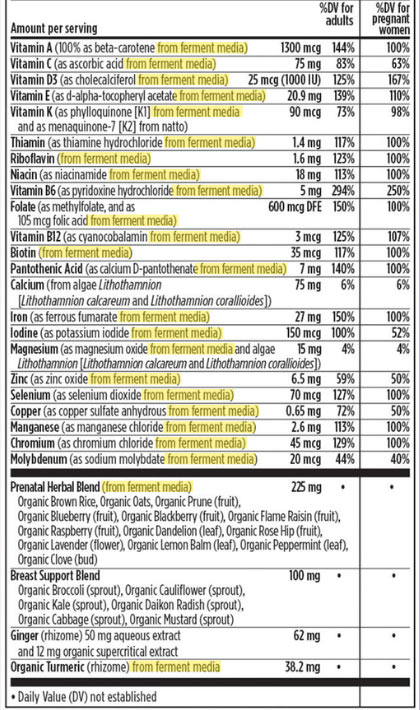
(Megafood, Pure Synergy, Garden of Life Vitamin Code or New Chapter are a few examples of brands that produce prenatal vitamins by fermentation.)
When prenatal vitamins don’t specify the source of nutrients, you can bet your money they contain synthetic USP vitamins.
True whole food prenatal vitamins should be extracted from whole foods and should not involve the addition of synthetic vitamins or culture media at any point of the manufacturing process.
Garden of Life Mykind Organics is a unique line of organic prenatal vitamins that are made almost exclusively from whole foods (with the exception of two nutrients that are from a cultured source). They’re available as once-daily prenatal, prenatal multi 3x/day, or prenatal gummies.



2. Folic acid VS. folate
Both folic acid and folate are a form of vitamin B9.
- Folate is a naturally occurring form of vitamin B9.
- Folic acid is a synthetic version of vitamin B9 that does not occur in nature.
All prenatal vitamins contain either folic acid or folate. As a matter of fact, any regular multivitamin does, but prenatal vitamins have a higher amount. The reason being, folate deficiency in pregnancy has been associated with serious birth defects of the brain and spinal cord in the developing baby, such as spina bifida and anencephaly.
According to the American College of Obstetricians and Gynecologists, pregnant women need at least 600 micrograms of folic acid daily. Because some of it is received from foods fortified with folic acid or from folate foods, it’s recommended that a prenatal supplement should contain at least 400 micrograms folic acid, which is equal to 667 mcg DFE (dietary folate equivalent). Or the equivalent of that in natural folate, which is measured differently due to a lower presumed absorption rate.
- 1 mcg DFE = 1 mcg food folate
- 1 mcg DFE = 0.6 mcg folic acid (consumed with foods)
Personally, I would stay away from prenatal vitamins that are formulated with folic acid.
Not only is natural folate highly bioavailable (as proven by many studies), some of us have inherited genetic mutations that can make it difficult or impossible for the body to absorb folic acid. It’s estimated that about 50% of the population has some type of polymorphism in the MTHFR gene that’s responsible for the metabolism of vitamin B9. (Read more about folate VS. folic acid, together with folic acid supplementation risks and dangers of consuming too much folic acid.)
No matter the form in your prenatal vitamins (folic acid or folate), you’ll want to have your folate needs covered in the earliest stages of your pregnancy because the birth defects that folate (folic acid) is supposed to help prevent occur during the first 4 weeks after conception. That’s why it’s recommended to start taking prenatal vitamins at least 1 month prior to pregnancy. In addition, make sure to eat plenty of high-folate foods!
3. Overall nutrient content
If you were to compare a few prenatal vitamin labels, you’d notice varying amounts of vitamins and minerals. These include vitamin A, C, D, E, K, B vitamins, calcium, iron, iodine, magnesium, zinc, copper, and possibly a few extras.
The nutrients in your prenatal multivitamin should be provided in reasonable amounts to support your health and the health of your developing baby. But, even a seemingly perfect balance of vitamins and minerals doesn’t guarantee that your body will be able to utilize all provided nutrients.
More is not always better.
Some nutrients may not be in the most biologically appropriate form (synthetic vs. natural vitamins), and others can cancel each other out. For example, calcium (from both foods and supplements) inhibits the absorption of iron and magnesium. In fact, zinc, magnesium, copper, and iron all compete with each other for absorption.
Calcium
Calcium is a bulky ingredient that greatly increases the size of a multivitamin. That’s why prenatal vitamins that do contain calcium often only have very small amounts. Luckily, calcium deficiencies in pregnancy are fairly uncommon so it’s generally not an issue for most women. The need for calcium in pregnancy is the greatest in the third trimester when the baby’s skeleton is rapidly developing.
If you want to take a calcium supplement in addition to a prenatal multivitamin containing iron, it helps to space them out.
Iron
Most prenatal vitamins contain at least some iron. One exception are gummy prenatal vitamins.
Iron may worsen early pregnancy nausea and can be constipating. Although iron is universally considered one of the key nutrients in a prenatal multivitamin, unless you’ve been diagnosed with iron deficiency anemia, you may not necessarily need extra iron until about the second half of pregnancy when the blood volume starts to rise significantly and the demand for iron increases. (The immediate need for a higher intake of iron in pregnancy is one of the common prenatal vitamin myths.)
Magnesium
Magnesium is another bulky ingredient that will blow up the size of a multivitamin to one that isn’t pleasant to take, so most prenatal vitamins are low in magnesium. And because magnesium competes with other vitamins and minerals for absorption, it’s a strategic move that it’s left out of some prenatal vitamin formulations altogether.
You can always buy a separate magnesium supplement and take it separately from your prenatal vitamin (I like this one, or this one for a vegan option).
Novel ingredients
Choline is a relatively newly-recognized nutrient. It’s closely related to the B vitamin family and, like folate, is believed to play an important role in the development of baby’s brain and spinal cord. Most prenatal vitamins contain no or very little choline. Naturelo Prenatal Vitamins are a blend of natural and synthetic (but well-thought-out) vitamins that contain a small amount of choline.


DHA (docosahexaenoic acid) can help with your baby’s brain, eye, and nervous system development. Not all prenatal vitamins contain DHA, and those that do can have an unpleasant smell and taste. Until recently, the most common source of supplemental DHA was fish. To avoid exposure to environmental contaminants like heavy metals and PCBs (polychlorinated biphenyls – highly toxic industrial chemicals still persistent in the environment despite not being used since 1977), some manufacturers have switched to synthesized algal oil. There is some controversy regarding algal oil, but at least it has no funky odor!
Iodine is important not only for maternal thyroid hormone production but also for the healthy development of baby’s brain and central nervous system. More brands are adding iodine to their formulations.
4. Consider all ingredients
Another key factor in choosing the best prenatal vitamins is going over the full list of ingredients. Prenatal vitamins can contain various additives that may have a negative impact on your health and the health of your unborn baby.
Take a note of the ingredient list for extras like synthetic dyes (all FD&C coloring agents), titanium dioxide, or annatto color. Synthetic dyes are completely avoidable in prenatal vitamins, and tests on pregnant rats revealed that intrauterine exposure to synthetic dyes can lead to learning and memory problems in the offspring. Titanium dioxide has been classified as possibly carcinogenic to humans, and annatto color, while a natural dye, can cause allergic skin reactions and gastrointestinal symptoms.
Prenatal vitamins made with synthetic dyes are more likely to contain other controversial ingredients that are on the long list of additives best avoided in foods and food supplements.
Related: 7 Popular Prenatal Vitamin Myths

5. The best prenatal vitamin form
Many brands make various forms of prenatal vitamins. Which one will give you the most benefits?
Tablets VS. capsules VS. gummies
To be fair, there are other forms of prenatal vitamins like powders or liquids, but tablets, soft gel capsules, and gummies seem to be the most common forms.
Tablets tend to be the most cost-effective option because they’re less expensive to make than other forms of multivitamins. They retain their potency for longer periods of time and are therefore the most shelf-stable choice. Tablets also allow manufacturers to sneak in more nutrients. The one negative is that their hardness can make it difficult to swallow for some pregnant women, especially when morning sickness kicks in. This is made even worse when you have to take several tablets a day. The absorption rate isn’t the best and depends on how evenly the tablet breaks down in the digestive tract.
Capsules are softer thus easier to swallow than tablets. The nutrients come in a soft powder form which means they dissolve better and are delivered quickly. Capsules don’t contain flavorings or binders. The downside is that capsules tend to be more expensive. They are sometimes made with animal gelatin, but many are vegan-friendly and made with a plant-based coating instead.
Gummy vitamins – easy to swallow, taste like candy, is there a better way to take a multivitamin? The downside is that gummies don’t contain as many vitamins and minerals as tablets or capsules because it’s difficult to incorporate certain nutrients into them (for example, it’s rare to find a gummy vitamin that contains iron), and the amounts of many nutrients in gummy vitamins are significantly lower compared with tablets or capsules. But, what they lack in strength, they make up for in absorption rate. Some gummy vitamins are made with animal gelatin, but you can find vegan options, too.
One-a-day VS. multiple pills daily
Taking just one prenatal vitamin every day is preferred by most women but not necessarily the best choice in terms of utilizing all nutrients unless you eat a fairly varied diet. Some vitamins are water-soluble and some work better when eaten with fat, so for example if you take your once daily prenatal vitamin with breakfast each day and your breakfast mostly consists of cereal with skim milk, it will be hard for your body to utilize any fat-soluble vitamins.
If a package of prenatal vitamins calls for multiple servings per day, they can be taken all at once, or split up and taken at different times. Spreading the dose may be inconvenient (you may forget to take the rest), but it can help with absorption, giving your body a chance to digest and process nutrients with a changing food matrix.

Choosing the best prenatal vitamins
The best prenatal vitamin should be able to cover your increased nutritional needs, so be honest with yourself – do you feel like your diet has been lacking lately? Then prenatal gummies may not be enough to bridge the gap between what you’re getting from food and what you should be getting in pregnancy, and tablets or capsules might be a better choice.
Keep in mind that a fully synthetic formulation may have a considerably poorer absorption rate compared with natural whole food prenatal multivitamin. On the other hand, synthetic USP nutrients don’t degrade as rapidly, so the potency of each nutrient is more reliable compared with a natural whole food multivitamin.
Your prenatal vitamins should come in a form that you’ll be able to tolerate well and take regularly. You can’t get any benefits from something you stop taking. The most common complaint about prenatal vitamins is that they can be so darn humongous. Oversized supplements just don’t go hand in hand with morning sickness, and it’s one of the things that pregnant women dislike the most about prenatal vitamins (smell is a close second).
Nonetheless, your body’s response to any particular prenatal vitamin formulation is not something you can address ahead of time. Even after choosing prenatal vitamins carefully and for all the right reasons, you may need to seek a more compatible prenatal multivitamin brand or type if the one you pick makes you feel unwell. You just never know!
(But… fingers crossed your first choice for a good prenatal vitamin is your final.)
Even if you take the best prenatal vitamins on the market it’s still important to maintain a healthy diet in pregnancy to your best ability. A healthy pregnancy starts with a balanced diet that provides a variety of vital nutrients to your developing baby.
Do you *have* to take prenatal vitamins when you are pregnant? Not necessarily. You can support a healthy development of the baby with just your diet alone, but a good prenatal vitamin is a good way to hedge your bets. It can help you cover any nutritional gaps that you might have. If you decide not to take a prenatal multivitamin, your healthcare provider will likely advise you to at least stick with folic acid during the first trimester to help prevent the risk of neural tube defects that can happen in the first month of pregnancy.
If you take any separate supplements in pregnancy on top of prenatal vitamins, such as additional calcium to support baby’s bone health, or extra magnesium, keep in mind that you shouldn’t mix them in order to maximize absorbency.
Disclosure: Consult your choice with your healthcare provider. You are urged not to take any advice contained in this article as a substitute for your doctor’s recommendation.






I enjoyed everything you said thank you for your research. I pray that the Lord will bless you richly.