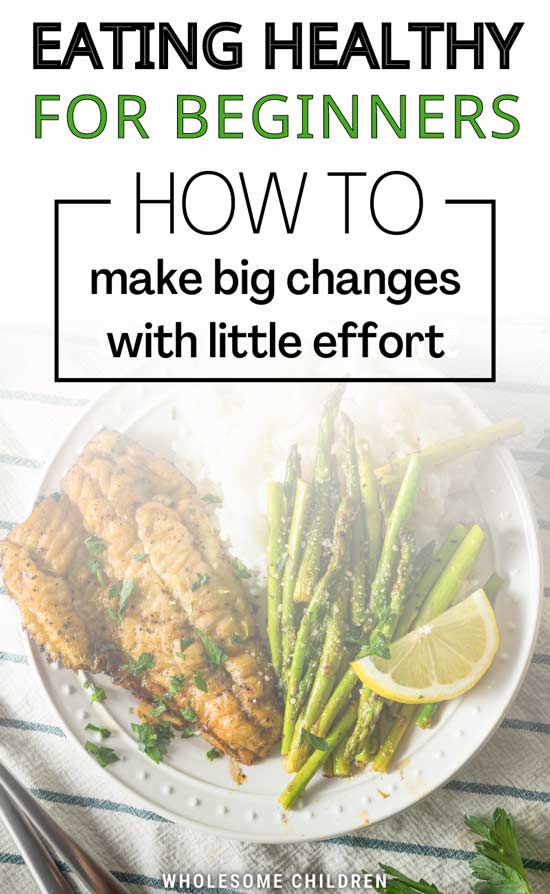
These days everyone and their dog has an opinion about what’s healthy and what’s not, because hot new science and TRENDS. And the list of what to eat and what will slowly kill you is always changing, so better not get comfortable with your routine. I’m not going there – tell me what mood the science is currently in about the habit of coffee indulgence and I’ll have mine with a slice of chocolate cake with my eyes rolled back. Instead, I want to share a few practical tips for *super simple* changes you can make in your kitchen for cleaner and healthier eating without following any trends, and best of all – without dieting! This is a common-sense approach to healthier eating that no amount of food industry science can dismantle (though they try, oh how much they try).
This website uses referral links. Please read our disclosure policy for more information.
8 Super simple real food switches for better health
Here we go…
#1 Dairy
If you buy cow’s milk or any other dairy products, keep in mind that the specific milk used can make a dairy product more or less nutritionally dense. Grass-fed milk tends to be better for your health when compared with conventional milk.
But first… I have to get something off my chest.
The western world consistently grooms its market into believing that cows simply exist to produce milk. That’s not true! Jolly-good dairy commercials portray cows in bucolic bliss. They are given names and treated with love and respect. In reality, that’s barely ever the case.
The dairy industry doesn’t like to show its dark side – cows being exploited for milk. A cow only produces milk for her offspring, just like any other mammal. In reality, dairy cows endure a cycle of back-to-back pregnancies while losing babies one by one, typically immediately after giving birth. The outcome is even worse for cows raised in industrial farming operations known as “factory farms” where animal abuse and torture is rampant and horrendous living conditions the norm. This isn’t a plot to get you off dairy, all right? I think everyone should be aware of the principles of dairy operations, and the truth is, many people aren’t. OK rant over. 😉
Aside from blatant animal abuse, conventional milk from industrial farming is lower in some nutrients than what it’s naturally designed to be. And it’s hardly surprising. Cows raised in these settings spend their entire lives indoors confined to tiny stalls or outdoors in muddy fields devoid of vegetation instead of out on the pasture where they belong.
When cows have access to the outdoors and are allowed to graze, their milk nutritionally improves. Grass-fed dairy is higher in beneficial nutrients such as omega-3, vaccenic acid, and conjugated linoleic acid. [source, source]
Certified-organic milk is at least partially sourced from grass-fed cows, so there you have one of the factors that drive the price of organic milk up. Per USDA regulations organic dairy farms must provide their cows with at least 120 days/year of pasture time, in other words 30% or more of their diet must come from grazing. In addition, all of the feed, including dried and fresh forages, must be organically grown. Still, there is quite a variation in the quality of “organic milk” available. Many “organic” dairy farms operate as factory farms, meeting only the bare minimum required to keep their certification, whereas other organic farms do much better and offer more pasture time and better living conditions for the cows overall.
Certified-organic GRASS-FED milk is all rage these days, but the term “grass-fed” isn’t clearly defined or regulated which opens door to label abuse.
So… how to find the best milk when you can’t rely on labels???
The Cornucopia Institute, a non-profit farm policy research group based in Cornucopia, WI breaks down the operational principles of individual dairy farms across the U.S. and rates the quality of organic dairy brands based on farming practices. Organic Valley and Maple Hill Creamery available nationwide score very well, but some brands have even better scores, so see if any of them are available in your area. By clicking on each brand you will find more detailed information about feed type, pasture time, milking frequency, hormone and antibiotic use, as well as milking herd and calf management.
If you go grass-fed, choose full fat dairy. Much of the added benefits of grass-fed dairy lie in the fat content, so you wouldn’t want to rob yourself of the perks.
For organic yogurt ratings by the Cornucopia Institute, check here. Ratings reflect the quality of milk and ingredients used. If quality yogurts don’t fit your budget, you can always buy the large-size tub of the ordinary plain kind and either eat as is or add granola, seeds (pumpkin, sunflower, chia, hemp, etc.), berries, banana, whatever you fancy. Sweeten with maple syrup or honey if needed.
#2 American cheese
American cheese remains the most popular choice for making grilled cheese sandwiches. Which is ironic, because it’s not really cheese. Right there on the label in bold letters it is stated: “pasteurized prepared cheese product.”
Compare this list of ingredients:
Milk, Cheddar Cheese (Milk, Cheese Culture, Salt, Enzymes), Whey, Milk Protein Concentrate, Milkfat, Calcium Phosphate, Sodium Phosphate, Contains Less than 2% of Modified Food Starch, Whey Protein Concentrate, Salt, Lactic Acid, Annatto and Paprika Extract (Color), Natamycin (a Natural Mold Inhibitor), Enzymes, Cheese Culture, Vitamin D3.
…with this one:
Milk, Salt, Cheese Culture and Enzymes.
One is real cheese, the other is American cheese.
Any sliced (real) cheese is a healthier option than American cheese.
Cheddar is a great choice for a grilled cheese sandwich, and so is Colby, Muenster, or Monterey Jack. Or Provolone. On Mediterranean-style grilled sandwiches, Mozzarella won’t disappoint.
The fewer ingredients your cheese contains, the better for your health. If you choose cheese made with milk from grass-fed cows, even better!
#3 Eggs
The vast majority of eggs on the market are factory-farmed eggs. These eggs are sourced from hens that live crummy sad unhealthy lives in awful conditions.
Animal cruelty aside, we’ve all heard it:
“Eggs laid by hens kept in cage-free or pasture raised environments aren’t significantly more nutritious than regular eggs laid by hens kept in a cage, chicken researchers and dietitians say.”
Well that’s because these “chicken researchers and dietitians” compare the eggs from caged factory-farmed hens with cage-free factory-farmed hens and have a poor understanding of the concept “pasture-raised.”
Pasture-raised hens have the ability to roam freely and forage for foods that make up their natural diet – wild plants, insects, bugs, and worms – in addition to a supplementary feed. “Cage-free” only signifies that the hens aren’t kept in tiny cages, but their living conditions are otherwise nearly identical to those of “caged hens.” Neither have access to the outdoors.
A 2010 Penn State study showed that eggs produced by hens that are allowed to forage in pastures are much higher in vitamins A and E, and have twice as much omega-3 fatty acids and a healthier balance of fatty acids when compared with hens with no outdoor access relying on commercial feed only. [source] Another study showed that the vitamin D3 content of egg yolk was three- to fourfold higher in the hens that were exposed to sunlight compared with hens raised indoors. [source]
How to find the most nutritious eggs?
Avoid these egg labels:
- conventional eggs – no labeling (no outdoor access)
- cage-free eggs (no outdoor access)
- farmed-raised eggs (hello greenwashing)
- all-natural eggs (more greenwashing)
- free-range eggs (a widely abused label – limited outdoor access, no regulations, not an indication that hens spend time outside)
Specifically look for:
- pasture-raised eggs/pastured eggs
Pasture-raised eggs are much more expensive than conventional eggs because it costs more to raise hens in this way, but you should be getting a much more wholesome egg in return.
Organic eggs must come from hens that have access to the outdoors, but the outdoor space and usage isn’t regulated in any way, so just organic labeling alone isn’t a guarantee of hens actually spending any quality time outside. You really want that “pasture-raised” or “pastured” label in addition if you are buying your eggs at the grocery store and proof – the egg yolk should be a deeper orange color compared with conventional eggs.
Organic pasture-raised egg would theoretically be the highest-rated egg on the grocery store shelf today. On the other hand, small farmers may fulfill the criteria or exceed them but opt out of getting certified organic for financial or other reasons. Many small farmers may not even associate their eggs with the term “pasture-raised” because that is naturally how they’ve always raised their hens – roaming, so don’t be alarmed if your local eggs aren’t specifically marked “pasture raised.”
We don’t have convenient access to quality eggs in our area and buy Vital Farms eggs which are widely available and taste really good. They have a nice rich-orange yolk and actually outperformed some of the local eggs we’ve tried before. The Cornucopia Institute has a scorecard for eggs as well, if you’re interested.
#4 Peanut Butter
If you buy peanut butter, do yourself a favor and choose one that only contains peanuts (or peanuts and salt) and no added ingredients.
Peanut butter can really just be (and should only be!) ground up peanuts, but many mainstream brands like to add extras like hydrogenated vegetable oils (canola, soybean), sugar, and emulsifiers that help blend the contents together. All of these highly processed nutritional monstrosities are completely unnecessary in your jar of peanut butter.
Without added emulsifiers, pure natural peanut butter will separate into oil and peanut paste. Just stir before using. It’s not a big deal.
Treat any nut or seed butter the same.
#5 Healthier oils
The healthiest cooking oil with the most nutritional benefits is one that has been minimally processed. Some of the well-known least processed cooking oils that have been extracted mechanically as opposed to chemically are:
- cold-press virgin coconut oil
- cold-pressed avocado oil
- extra virgin olive oil (EVOO)
There is a widespread belief that unrefined mechanically-extracted oils are best used raw – as a topping or in a salad dressing, or for cooking at low heat. Much literature cautions against exposing unrefined oils to high temperatures.
This has to do with thermal stability of oils. Every cooking oil has a specific smoke point – a temperature at which the oil begins to produce a smoke. Heating the oil beyond smoking causes the oil to break down into carcinogenic compounds (this process is known as thermal oxidation). Doing so may also alter the taste of the food itself. That’s why you wouldn’t want to use a cooking oil in high-heat preparations if its smoke point is relatively low. Generally speaking, the more refined (processed) the oil, the higher its smoke point.
It has however been long debated whether smoke point is a good indicator of the stability of cooking oils, and a growing body of research suggests otherwise.
First of all, many cooking oils are unstable even before reaching their respective smoke point. Some oils are just more prone to oxidation whether stored in your cupboard or used for cooking or frying. Particularly susceptible to oxidation are oils with a high polyunsaturated fat content such as the widely popular corn, soybean, safflower, grapeseed, and sunflower oils. Canola oil is another one to add on that list even though it’s primarily monounsaturated fat.
On the other hand, quality extra virgin olive oil (EVOO) may not be a terrible choice for cooking after all. [source] Avocado oil has a fairly high smoke point even in its raw unprocessed state (must be cold-pressed) which makes it a great option for cooking, too. **A detailed guide on safe cooking oils and fats is in the works and coming soon, keep your eyes peeled!**
In addition, avoid all butter substitutes such as margarine whether alone or as an additive in foodstuffs. Unless you are a vegan, real butter is an excellent source of essential vitamins such as vitamin A, D, E, K2, and B12 and helps with the absorption of fat-soluble nutrients. [source] If you don’t have access to quality butter straight from the farmer, Kerrygold butter tastes delicious and is widely available at stores nationwide. Kerrygold is based in Ireland where the weather is mild, and their cows are out on the pasture nearly all year round. Kerrygold butter is superior to any store-brand “organic” butter. It’s noticeably deeper in color and tastes a whole lot better, too.
Also stay away from: Crisco.
Soybean Oil, Fully Hydrogenated Palm Oil, Palm Oil, Mono And Diglycerides, TBHQ And Citric Acid (Antioxidants).
There are mechanically-pressed oils, refined solvent-extracted oils, and then there is Crisco.
#6 Maple syrup
Real maple syrup is made by boiling the sap of the maple tree. No other ingredients are added to maple syrup. Real maple syrup not only tastes delicious, but unlike “pancake syrups” it also contains valuable nutrients.
Just 1 tablespoon of pure maple syrup contains 33% DV of manganese (which reduces inflammation and is essential for bone health), 6% DV of zinc, and traces of calcium, iron, magnesium, potassium, and copper. Surprisingly, maple syrup contains more minerals than honey. Pure maple syrup is also high in antioxidants, just like honey. [source, source]
The ever popular pancake syrups are made with sweeteners like corn syrup and high fructose corn syrup, thickeners, preservatives, and are artificially flavored and dyed to mimic the real syrup color and taste. Pancake syrup has zero nutritional value to add to your body.
Aunt Jemima Syrup (Original): Corn Syrup, High Fructose Corn Syrup, Water, Cellulose Gum, Caramel Color Salt, Natural And Artificial Flavor, Sodium Benzoate And Sorbic Acid (Preservatives), Sodium Hexametaphosphate.
Mrs. Butterworth’s Syrup (Original): High Fructose Corn Syrup, Corn Syrup, Water, Salt, Cellulose Gum, Molasses, Natural And Artificial Flavor (Lactic Acid), Sodium Hexametaphosphate, Preservatives (Potassium Sorbate, Sodium Benzoate), Caramel Color, Citric Acid.
Log Cabin Syrup (Original): Corn Syrup, Liquid Sugar (Natural Sugar, Water), Water, Salt, Natural and Artificial Flavor (Lactic Acid), Sodium Hexametaphosphate, Preservatives (Sodium Benzoate, Sorbic Acid), Caramel Color, Phosphoric Acid.
Maple syrup: maple syrup.
Maple syrup is broken down into grades by color and taste. These qualities are dependent on when the sap was harvested. Generally, the sap is collected for 4-6 weeks between late February and early April. Syrup made from an early tapping is lighter in color and milder in taste compared with a syrup produced later on in the maple syrup season. As the season progresses, the syrup darkens and the flavor becomes more intense.
The grading of maple syrup changed a few years ago to bring the U.S. and Canadian grading systems on the same level and to level out some regional grading discrepancies as well. The new grading system reduced the grade variety by overlapping some of the former grades.
Now there are only 3 grades of table-grade maple syrup:
- Grade A Golden Color (light in color, smooth maple flavor)
- Grade A Amber Color (darker color, rich taste)
- Grade A Dark Color (dark amber color, robust taste, formerly Grade B)
Grade A Amber seems to be the most popular grade for waffles and pancakes. We prefer the deeper flavor of Grade A Dark (formerly Grade B) but don’t scoff at other grades. They’re all delicious! (I particularly like the one sold at Trader Joe’s in a smaller glass package labeled “Organic Vermont Maple Syrup.”)
How to ensure you’re getting pure maple syrup? Check the ingredient list to confirm that the syrup only contains maple syrup and nothing else. Pure maple syrup is much pricier than its fake counterparts, but keep in mind that maple syrup has a rich taste and you’re more likely to use less of it.
#7 Bread
Bread doesn’t need to be made with very many ingredients. But often, commercially prepared bread is. The laundry list of common bread ingredients includes oils with low oxidative stability (polyunsaturated fats), dough conditioners, preservatives, sweeteners (including artificial ones), and of course highly processed white flour.
Processed white flour is stripped of vital nutrients and consequently refortified with a small portion of the nutrients lost in the processing which doesn’t make the flour much healthier. On the contrary, flour fortification with folic acid can be problematic in a significant percentage of the population. White flour equals empty calories, and consuming too much of it can contribute to obesity, heart disease, and diabetes. [source]
A loaf of bread made with 100% whole wheat flour (ground-up wheat berries) will provide your body with more fiber, vitamins, and minerals. Make sure to check the list of ingredients for “whole wheat flour.” When bread is only labeled “whole wheat” it is usually made with a white/whole wheat flour blend. Still, consuming less flour and more actual grains will give you additional health benefits.
Sprouted grain bread is an excellent choice. This method of bread making is nothing new, it has been around for thousands of years. Soaking and sprouting grains preserves vital nutrients while breaking down antinutrients like phytic acid which binds to vitamins and minerals and interferes with their absorption. The nutrients in sprouted bread are not only more abundant but also more bioavailable.
Ezekiel bread is one such example of sprouted grain bread. This brand is generally widely available – you’ll usually find it in the freezer section of your grocery store. Ezekiel bread is made from sprouted organic whole grains, legumes, and seeds, and contains no artificial ingredients or preservatives. The only other ingredients are generally yeast, sea salt, and wheat gluten. Ezekiel bread is a great source of amino acids, B vitamins, and fiber. Because the bread is made without preservatives it tends to grow mold easily, so it’s best stored in the refrigerator (or freezer).
Some of the most widely available brands of sprouted bread are:
- Food For Life (makes Ezekiel bread)
- Silver Hills Bakery
- Dave’s Killer Bread
- Alvarado Street Bakery
- Angelic Bakehouse Bread
See them all here for a comparison.
A note about Ezekiel (sprouted grains) bread: It’s not gluten-free, and may not be suitable for those with irritable bowel syndrome (IBS) given the higher content of fiber and seeds.
Another method of making bread more nutritious compared with traditional white bread is fermentation. One of the oldest forms of grain fermentation is sourdough. You can find quality sourdough bread at health food stores, farmers markets, and traditional bakeries.
#8 Better meat
Meat products or in other words highly processed meats such as lunch meats, store-bought meatballs, sausages or hot dogs tend to contain too much sodium and are filled with flavoring agents, fillers, preservatives, and rumor has it a lot of secrets, too. This includes burgers from fast food chains and a good majority of all restaurants, too.
Meat bought from your local small farm where animals are treated right is generally the best quality and the healthiest. Other than that, look for meat that is ethically grown and wholesome such as grass-fed beef or pasture-raised chicken. Quality meat is substantially pricier than conventional, but you can level out the price difference somewhat by eating smaller quantities of meat.
Related: 21 Tips for Big Savings on Healthy Groceries
Organic certification alone is not necessarily a sign of meat of superior quality, although it does mean that the animal would have been fed a cleaner diet overall. Unfortunately, organic-certified producers often aren’t growing their animals in conditions otherwise much different from standard factory farming if it’s a large-enough operation. On the other hand, many small family farms can’t afford the extra costs associated with maintaining organic certification yet operate within the same or even higher standards than government agencies require and often sell healthier, more sustainable meat than big “organic” farms.
Fish is on most dietary recommendations, with limits attached to some fish like tuna which is prone to high heavy metal concentrations due to environmental pollution and thus its consumption should be limited. Swordfish is another type of fish known to contain high levels of mercury that is best avoided altogether. As a general rule, the smaller the fish and the lower it is on the food chain, the fewer heavy metals and toxins it will have accumulated in its lifetime.
More fish to avoid:
- farmed salmon
- tilapia (also a farmed fish)
You get out of a farmed fish what you put into it, just like standard farm-raised meat.
Farmed tilapia and salmon are almost always raised with low standards. Overcrowding, low-quality feed, and low water quality are common in fish farming. As a result of these poor conditions, farmed fish are prone to diseases and must be routinely treated with antibiotics which raises the levels of residual antibiotics in the fish. When compared with wild-caught fish, farmed fish tend to contain more toxins overall. [source, source] Farmed fish may be higher in beneficial omega-3 fatty acids if their feed is omega-3 fortified, but that doesn’t make farmed fish any healthier.
It seems that Asian-raised tilapia continues to score very low if you have a moment to weed through the list. China in particular is known for some of the worst tilapia farming conditions, so I would highly recommend staying away from all frozen tilapia sourced from China. (In all fairness I would be hesitant consuming ANY foods coming from China.)
Better choices in fish selections include:
- wild-caught Alaskan salmon
- Pacific cod
- farmed rainbow trout
Farmed rainbow trout is one exception on this avoid-farmed-fish list. Rainbow trout is a type of fish that won’t survive in conditions that are less than perfect. The water must be clean, and the fish not stressed. Farmed rainbow trout are generally raised in better conditions than other farmed fish and contain minimal levels of contaminants. The majority of rainbow trout sold in the U.S. is also raised right here in the U.S.
We are what we eat.
After all, we aren’t much different from farmed animals. As much as I don’t mind perusing individual studies, common sense tells me that I don’t need scholarly literature to understand that eating natural whole foods beats lab-made substitutes and otherwise altered foods in a plethora of ways.
Eat good food. Eat as much real whole foods as possible. Cut back on processed foods and sugary drinks. Incorporate a variety of vegetables into your meals. Every once in a while try a new vegetable or fruit. Enjoy your food! (Even the sugary treat that you know isn’t the best for your health.) Cook more. Learn to listen to your body’s cues in taste, cravings, and feeling full.
Food is more than just a basic need to get by. Food can make us, or break us. It’s that simple.