
Looking for non-toxic diapers that are safe for your baby? The safest diapers don’t contain various problematic chemicals that diapers can simply be made without, such as phthalates, dioxins, VOCs, heavy metals, and several others. Non-toxic baby diapers reduce the risk of diaper rash, exposure to harmful chemicals, and they’re safer for the environment.
In this article we’ll zoom in on the best non-toxic diapers available in 2023, so get ready to take notes if you’re looking for a safer diaper or want to confirm that the diaper brand you’re currently using is indeed safe for your baby!
What will you find in Best Non-Toxic Diapers 2023?
- Ingredients: Many brands label their diapers as “natural” and “eco-friendly”, but these green marketing claims are not always 100% accurate. It’s worth looking a little deeper into each of those claims to see which materials are actually being used.
- Reviews: I’ve done the tedious job of analyzing thousands of reviews from a variety of sources with the goal to narrow down each diaper’s performance. Even the very best non-toxic diapers still have to perform reasonably well or else they are useless, right?
- Cost: Since the safest disposable diapers tend to be made with higher quality and pricier materials, they typically cost more. I have factored in the cost for each brand as well to give you an idea of the price point and options for your budget.
The safest diapers
Various different criteria can be applied to narrow down the search for the safest non-toxic diapers on the market. I use the following features as a ranking factor to even consider a brand for this guide:
- No fragrance: Fragrance is an unnecessary diaper add-on that can expose your baby to a long list of unknown chemicals which can lead to respiratory issues and skin reactions. No diapers on this list contain any sort of added fragrance.
- 0% chlorine: Some of the diaper materials, such as the fluff pulp in the core, undergo bleaching as part of processing. The two main bleaching methods used in pulp mills today are elemental chlorine-free (ECF) and totally chlorine-free (TCF) bleaching. The first uses chlorine derivatives which can generate the formation of residual chlorinated dioxins; the second uses no chlorine compounds whatsoever. All diapers on this list contain totally chlorine-free fluff pulp and other applicable materials in the top and back sheet.
(A quick read on why avoiding common chemicals in disposable diapers (including dioxins) is probably a good idea.)
- Dyes: It seems that the disposable diaper industry no longer uses harmful disperse dyes which are known sensitizers (they’re still used in the textile industry, especially on dyed polyester fibers, so beware if your baby has very sensitive skin!). The color touch on disposable diapers today is achieved with various types of inks/pigments which seem to have a reasonably safe profile. That said, I wouldn’t recommend using diapers that have a dyed inner liner and/or leg cuffs because of direct exposure to unnecessary coloring agents.

+ Many diapers on this list are also rendered free of:
- phthalates
- organotins (TBT, DBT)
- VOCs
- heavy metals
- other problematic chemical compounds
(Each description will tell you more.)
Related: The Ups & Downs of Using Cloth Diapers (Honestly. No Fluff!)
This website uses referral links. Please read our disclosure policy for more information.
Best non-toxic diapers 2023
5 important things to be aware of:
- All diapers on this list are made with totally chlorine-free (TCF) wood pulp.
- This list DOES NOT INCLUDE *ALL* TCF diapers on the market!
- Featured diaper brands are listed in alphabetical order. Placement does NOT reflect ranking.
- NEW THIS YEAR: Both the avoidance to toxins + performance evaluation are a ranking factor. This means that some brands have been set aside based on weak performance (details below).
- This guide includes the safest non-toxic diapers made with varying amounts of plant-based materials as well as those that are mostly petroleum-based. Eco-friendly points for each brand are included in each description if you’re interested in that aspect.
I have requested samples from some of the companies featured in this review so that I can more accurately describe the unique features of each diaper. All opinions are my own. I’m not being incentivized in any way, shape, or form to promote any particular diaper brand over others.
Diaper brands reviewed:
>> Clicking on each brand will take you directly to that section of this review.
- Abby & Finn
- Andy Pandy
- Bambo Nature Dream
- Coterie
- Happy Little Camper
- Eco Pea
- Healthybaby (Healthynest)
- Joonya
- Kudos
- Little Toes
- Pura
(See individual descriptions for details.)
FYI:
- Hello Bello and Millie Moon diapers are no longer TCF in 2023.
- Honest + Seventh Generation brands are still TCF (totally chlorine-free) but have been set aside for now based on consistent poor performance.

Don’t miss!! >> A chart at the end to compare the best non-toxic diapers featured in this review side by side!
Terms used in this article:
Top sheet – diaper’s inner lining
Back sheet – diaper’s outer layer
TCF – totally chlorine-free
ECF – elemental chlorine-free
SAP – superabsorbent polymer (sodium polyacrylate)
(More on TCF vs. ECF, SAP, and different diaper components and ingredients here.)
Related: Hidden Toxins in Baby Products (+ Safe & Natural Replacements!)
ABBY & FINN
Buy: Amazon | Abby & Finn
Wetness indicator: No
Sizes: 1-7
Cost: $-$$-$$$
Made in: Mexico
Free of: fragrance, chlorine, lotion, dyes, latex, heavy metals, known allergens, known environmentally harmful substances, phthalates, fluorine, PFOAs
Based on being devoid of fragrance, lotion, chlorine, and a handful of additional problematic substances, Abby & Finn diapers qualify for this best non-toxic diapers list. That said, this is a diaper made with petroleum-based materials all around with the exception of the wood pulp in the core, so it may not be one of the safest diapers on this list for you if you have environmental goals in mind as well.
What are Abby & Finn diapers made of?
Both the top sheet and back sheet of Abby & Finn diapers as well as the leg cuffs are made with polypropylene fibers. Polypropylene is also used in the absorbent core together with polyester (for the core wrap and acquisition layer), in addition to SAP and totally chlorine-free fluff pulp (sustainably sourced and FSC certified). The leak-proof barrier in the back sheet is polyethylene. Extra points to Abby & Finn for transparency over the materials used!
Abby & Finn diapers in a nutshell:
Abby & Finn diapers are available in a plain white design and prints (there are 5 gender-neutral designs to choose from, printed with natural, water-based inks). The diaper has a good amount of stretch in the back panel but no wetness indicator. The right closing tab features the diaper size.
Abby & Finn diapers are currently not available on Amazon. When they are, it’s a convenient way to try a pack (check availability here). When ordering directly from Abby & Finn, your options include single packs and a subscription bundle. The bundle brings down the cost of each diaper by a few cents and you save on shipping. It’s fully customizable and includes 3+ packs of diapers (mix and match prints and sizes). Baby wipes are an optional add-on.
Good to know: Abby & Finn diapers run small compared to other brands. Abby & Finn recommends sizing up if this is your first time ordering them, and they provide a very helpful comparison guide (scroll down to: “Compare us with other leading brands”) that will help you decide on the right size if you have previously used several other well-known diaper brands.

Eco-friendly points: the TCF fluff pulp in the absorbent core is sustainably sourced and FSC-certified.
ABBY & FINN diapers reviews:
+ Soft
+ Absorbent
+ No skin irritation
+ Good amount of stretch
– Too small/narrow
– May not hold enough overnight
– No wetness indicator
Summary:
- Abby & Finn diapers are often seen as more “natural” than traditional diaper brands when in fact they are made almost exclusively with petroleum-based materials (if we’re not counting the fluff pulp in the core). Other than that this is a solid diaper with an average softness and decent absorbency.
- Because they are cut smaller and narrow, Abby & Finn diapers may not provide a good fit for chunkier babies. Some parents never found a good fit even when sizing up due to how narrow the diaper is.
- Overall, the most common negative feedback has to do with the size and fit of the diaper (which the company clearly addresses on their website).
ANDY PANDY


Buy: Amazon | Andy Pandy
Wetness indicator: Yes
Sizes: NB, S, M, L, XL
Cost: $-$$-$$$
Made in: China
Free of: fragrance, chlorine, lotion, dyes, alcohol, preservatives, phthalates, latex, PVC, TBT
Andy Pandy diapers are made with bamboo fibers (bamboo viscose) in the inner and outer layers (top and back sheet).
(Learn about the pros and cons of bamboo diapers here.)
What are Andy Pandy diapers made of?
The top sheet and back sheet of Andy Pandy diapers is 100% bamboo viscose. Andy Pandy states that the bamboo they source is grown without chemical fertilizers and pesticides. Some components of the diaper are petroleum-based and made with polyethylene and polypropylene (leak-proof barrier, closure system, leg cuffs, and parts of the core). The core absorbency is achieved with SAP and totally chlorine-free fluff pulp (TCF).
Andy Pandy diapers in a nutshell:
Made with bamboo fibers in the top and back sheet, Andy Pandy diapers are naturally soft. They have a stretchy back, wetness indicator, and a classic all-around white look (no prints). One downside in the design is that the diapers don’t have sizes printed on them, so it may be harder to tell which diaper is which size when you are in between sizes or have more kids in diapers.
Andy Pandy diapers are made with safe materials, but the top sheet has a light coating of aloe vera to soothe and nourish the skin, so keep that in mind if you’re looking for natural chlorine-free diapers without any unnecessary add-ons.
Good to know: Andy Pandy diapers run large. Compared with mainstream diapers like Pampers or Huggies, Andy Pandy diapers are cut longer and wider. Even in the Newborn size, the diaper is larger than the typical newborn size of either of these brands.
You can find Andy Pandy diapers on Amazon, or on the Andy Pandy website as single packs or bundles. Andy Pandy subscription bundle saves you 5% and you set the amount and shipping frequency. It’s just diapers since Andy Pandy doesn’t make baby wipes that you could add on.
Eco-friendly points: The top and back sheets of Andy Pandy diapers are bio-based (bamboo viscose). According to Andy Pandy, 86.5% of the diaper is now biodegradable.
!! While Andy Pandy has consistently scored as one of the top performing non-toxic diapers on this list, be aware that the reviews over the past year or so have shifted. See below.

ANDY PANDY diapers reviews:
+ Simple design
+ Soft
– Run large
– Too large for a newborn
– No visual difference between sizes
– Prone to leaks and blowouts
– Leaves clothing damp
– Rashes
– Some reports of chemical odor
Summary:
- In the previously published versions of this diaper review, Andy Pandy diapers typically received above average ratings. This all changed last year (2022) when the absorption capacity seemed to have decreased. At the time it wasn’t all that unusual given the widespread supply chain disruptions forcing changes on the production lines, but Andy Pandy doesn’t seem to have bounced back from it.
- Fast forward to 2023, aside from the generous sizing which has always been the case and the higher likelihood of moisture seeping to the outer surface which can be common with bamboo diapers, there are now many reports of chemical smell, leaks and blowouts, and rashes.
- If you’re looking for an eco-friendly disposable diaper, then Andy Pandy hits the spot. If you’re looking for an eco-friendly disposable diaper with good absorbency and decent leak protection, you might want to look elsewhere for now.

— BAMBO NATURE: DREAM COLLECTION


Buy: Amazon
Wetness indicator: Yes
Sizes: 1-6
Cost: $-$$-$$$
Made in: Europe
Free of: fragrance, chlorine, lotion, dyes, phthalates, parabens, latex, adhesives with optical brighteners
For some reason, many parents assume that Bambo diapers contain bamboo-sourced ingredients (is it the name?), and that is not the case. In addition, many reviewers take pride in using Bambo Nature diapers because they are “organic” and “biodegradable” – which they are not. I’m thrilled for any parent that finds a diaper that works for their baby and budget (up top!), but I’m puzzled as to why these conclusions continue to be made because Bambo is actually very upfront about the materials they use.
What are Bambo Nature diapers made of?
The top sheet and back sheet of Bambo Nature Dream diapers (and likely the leg cuffs as well) consist of polypropylene fibers, with a polyethylene film in the outer cover to prevent leaks. The absorbent core components include sustainably sourced (FSC certified) totally chlorine-free fluff pulp, SAP, and polyester. Petroleum-based components also ensure functionality in the fastening system and elastics.
Bambo Nature diapers in a nutshell:
Bambo Nature Dream diapers have a flat non-stretchy back, but the side panels are flexible. The diapers have a simple white design with a small printed front panel that features the diaper size as well, and all sizes have a wetness indicator that makes it easy to see when a diaper change is needed.
Bambo Nature Dream diapers have a Nordic Swan Ecolabel certification. Maybe this is where some of the confusion over the material sourcing comes from, but the Nordic Swan Ecolabel doesn’t indicate that a product is entirely or even mostly bio-based. The label evaluates a product’s impact on the environment based on specific criteria for each product category. (Links to different certifications mentioned in this diaper review are located at the bottom of this page.)
Eco-friendly points: FSC-certified TCF fluff pulp in the core, Nordic Swan Ecolabel certification.
In the last year’s update of the Best Non-Toxic Diapers Guide which was just around the time the new Dream line of Bambo diapers was released, I wasn’t able to summarize how well you can expect these diapers to perform because the feedback was either the best diaper ever!!! 🙂 OR… terrible, don’t bother… 🙁 .

Would you believe the score is no less muddled now, a year later? The feedback below that highlights the pros and cons of Bambo Nature diapers therefore doesn’t include key performance metrics such as absorbency or leak incidence because those are truly very balanced either way.
Good to know: Bambo also sells a nighttime diaper made with the same standards but higher absorbency (and the same love/hate feedback…).
BAMBO NATURE DREAM diapers reviews:
+ Slim fit under clothing
+ Size indication
– Wetness indicator not sensitive enough
– Inconsistent sizing
– Not a newborn diaper
Summary:
- Despite the name, Bambo diapers are made with plastic, not bamboo. Not a reason not to like them, but don’t get bamboozled?
- This is a very thin diaper. Some love it, others don’t. The sizing seems to be a bit off – the smaller sizes run bigger, whereas the largest sizes come out on the smaller side. Some say the fit is odd overall. The size indication across all sizes is a nice touch though.
- Is Bambo Nature a best non-toxic diaper contender? The ingredients are free of major chemicals of concern. The manufacturing is environmentally conscious. If you use Bambo Nature diapers and love them, you can sleep soundly, knowing they are made with care. If you’re considering them, toss a coin to see if you’ll love them or hate them. ¯\_(ツ)_/¯
- If you use Bambo Nature diapers, make sure that the leg cuffs are pulled out and not sticking to the diaper!! (The earliest rollout of this Bambo version had the ruffles sticking to the diaper, causing leaks. Could this still be an issue behind some of the negative reviews over leaks?)
— COTERIE

Buy: Coterie | Amazon | Whole Foods Market
Wetness indicator: Yes
Sizes: NB, 1-6
Cost: $-$$-$$$
Made in: Canada
Free of: chlorine, fragrance, lotion, dyes, alcohol, latex and natural rubber, VOCs, optical brighteners, heavy metals, parabens, phthalates. (Third-party tested.)
Coterie diapers contain neither fragrance nor chlorine and leave out several additional problematic chemicals that can lurk in disposable diapers. (You can view the safety report here.) This is a diaper made predominantly with synthetic materials that’s known for high absorbency.
What are Coterie diapers made of?
The top sheet (inner lining) is made of polypropylene; the back sheet (outer layer) consists of polypropylene and polyester fibers and polyethylene film in the leakproof barrier. The absorbent core contains polyester, SAP, and sustainably sourced totally chlorine-free fluff pulp (no certification).

Coterie diapers in a nutshell:
Coterie diapers have a simple white look with a logo on the front panel and a stretchy waist. They feel very soft and nicely padded in the core.

All sizes have a wetness indicator. Diaper size is not featured on the back sheet, but you can find it printed on the underside of the right closing tab in the format of SZ followed by a size number (such as, SZ2 for a size 2).
Coterie diapers are available on the Coterie website and newly at Whole Foods Market and with that, on WFM Amazon (must have a Prime membership).
The most common dissatisfaction over Coterie diapers has to do with the orders themselves on the Coterie website. Whether you go with a one-time purchase or subscribe to have diapers delivered (wipes are an optional extra), you have to buy a month’s worth of diapers (6 packs) each time. All boxes are one size only with the exception of NB size which is always split between sizes NB and 1. Single packs are not available for purchase through the Coterie website unless it’s an add-on to your subscription.
That said, Coterie does offer a trial pack for a small fee (plus shipping) if you want to try them without committing to a bulk order (you get two packs of diapers with 5 diapers in each pack; choose up to 2 sizes), or you can find single packs at your local Whole Foods Market and/or through Amazon.
Eco-friendly points: the TCF fluff pulp in the absorbent core is sourced from sustainably managed forests (but you’ll have to take their word for it because no certification backs this up).
Good to know: Coterie diapers have generously large leg cuffs for top-level protection from leakage – make sure the oversized ruffles are fully pulled out when the diaper is on to help minimize leaks.
COTERIE diapers reviews:
+ Simplistic look
+ Soft
+ Absorbent
+ Good for sensitive skin
+ No chemical odor
– Limited purchasing options
Summary:
- Coterie may not be a “natural” diaper material-wise, and it’s certainly a premium-priced diaper that will make you think twice before trying it, but performance reviews are actually pretty solid.
- Coterie diapers are soft, absorbent, and nicely padded without being bulky. They have a good amount of stretch in the waist and all around the diaper, and good coverage area.
- That said, if eco-friendliness is an important metric for you, this may not be your top diaper because it’s petroleum-based all around aside from the fluff pulp in the core.
— ECO PEA Co.
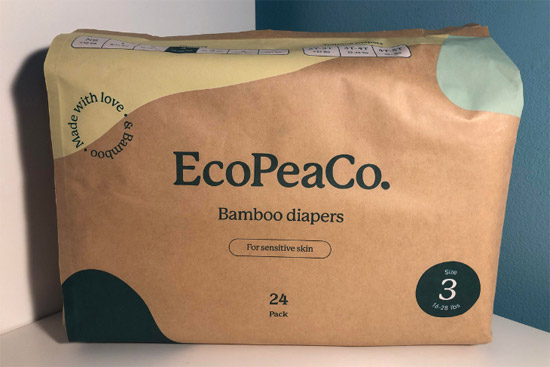
Buy from Eco Pea Co.
Wetness indicator: Yes
Sizes: NB, 1-6
Cost: $-$$-$$$
Made in: China
Free of: fragrance, chlorine, lotion, dyes, PVC, TBT, VOCs, gluten, phthalates, latex, alcohol, and formaldehyde + lead (third party-tested/Prop 65)
Eco Pea Co. is another bamboo diaper on this list and an excellent choice for those looking for high quality disposable diapers made from sustainable materials. Since these are bamboo diapers, they are made in China where the bamboo is harvested.
Related: Pros & Cons of Disposable Bamboo Diapers
What are Eco Pea diapers made of?
The top and back sheets of Eco Pea diapers are made of 100% bamboo fibers (bamboo viscose bleached with steam). The leakproof film in the back sheet is bio-based polyethylene.
What separates Eco Pea from other bamboo diapers on this list is that they don’t stop with the use of bamboo across the inner and outer layers of the diaper chassis but include bamboo in the absorbent core as well as a replacement for the more traditional wood-based fluff pulp. Bamboo is more sustainable than wood because of its quick growth rate, the ability to self-regenerate, and low maintenance. The bamboo fluff pulp Eco Pea Co. uses is totally chlorine-free and sustainably sourced (FSC-certified).
Some components of the diaper are made with petroleum-derived materials (SAP, elastics, distribution/acquisition layer, closing tabs and leg cuffs).
Eco Pea diapers in a nutshell:
Eco Pea diapers have a simple white design with only the brand logo printed on the front together with the diaper size for which earth-friendly water-based ink is used.

They have an elastic waistband in addition to stretchy side fasteners to keep your baby snug and comfy.

The diaper feels silky soft, very flexible, sturdy and luxurious, and the core has a nice amount of thickness to it for increased absorbency. All sizes have a wetness indicator.
Please note that Eco Pea diapers contain a small amount of aloe in the top sheet. Aloe vera has soothing properties for the skin, but it is an add-on that you should know about.
Eco Pea diapers are available exclusively through the Eco Pea Co. website.
You can choose between single packs and a diaper box (a bundle of 6 packs of diapers; baby wipes optional; free shipping). The box is available as a one-off purchase and subscription. The subscription box saves you $10 on each box and $19 compared to buying individual packs (which equals to one full pack of diapers), and you can adjust the delivery date and frequency of shipments. No commitment – cancel anytime.
All Eco Pea box orders are one size only, but you can add an extra pack to your subscription if you want to sample the next size up.
Eco-friendly points: Most of the diaper is made with sustainable, biodegradable bamboo, including the fluff pulp in the core. At least 85% of the diaper comprises biodegradable materials (biodegradability rate tested by SGS), and the packaging is 100% compostable paper. In addition, the company uses carbon neutral shipping.
Good to know: In general, bamboo diapers tend to run large and they are usually limited to a few basic sizes (S, M, L, XL), but that isn’t the case with Eco Pea diapers which come in a wide variety of sizes and are made to fit even newborns.
ECO PEA diapers reviews:
+ Soft
+ Absorbent
+ Simple white look
+ Great for sensitive skin
+ Durable
+ Size label
– ¯\_(ツ)_/¯
Summary:
- Eco Pea diapers are a sound choice for families looking for eco-conscious non-toxic diapers made with gentle ingredients and fierce performance. They tick all the boxes – soft, absorbent, breathable? Check. Hypoallergenic? Of course!
- Any baby with sensitive skin will love the soft non-irritating texture of bamboo.
— HAPPY LITTLE CAMPER


Buy on Amazon | Happy Little Camper
Wetness indicator: No
Sizes: NB/1, 2-5
Cost: $-$$-$$$
Made in: Europe
Free of: fragrance, chlorine, dyes, lotion, phthalates, parabens, lead, alcohol, latex, TBT, VOCs, PEGs (poyethylene glycols)
Happy Little Camper diapers have some natural components, but not as many as you might think based on the company’s marketing style.
What are Happy Little Camper diapers made of?
The top and back sheets of Happy Little Camper diapers are made with a blend of synthetic fibers and cotton. The cotton fibers are totally chlorine-free (bleached without chlorine derivatives), but the percentage of cotton in the blend isn’t disclosed.
For a brand targeting the eco-friendly crowd I don’t see a reason to withhold the blend ratio unless it’s not favorable numbers for the cotton content. They’ve never gotten back to me to clarify that either. Seeing that the diaper is up to 34% biodegradable (depending on the size) which isn’t a lot and mostly due to the fluff pulp which typically makes up around 30-40% of a diaper, the cotton content is probably low, but that’s just my assumption.
The cotton used is non-GMO, but it’s not organic. Conventional cotton is the most heavily sprayed crop and can contain residual pesticides and herbicides after processing, even GMO-free crops.
As for the “bio-core blend” (as referenced by Happy Little Camper), it’s just a way to address the fluff pulp in the core used in addition to chemical superabsorbers, which are the two key components of all modern disposable diapers. Other than that, the leg cuffs and core wrap are synthetic, and the rest of the materials are not disclosed.
Happy Little Camper diapers in a nutshell:
Happy Little Camper diapers are available on Amazon and in some retail stores. Only select sizes (and quantity) are available directly from Happy Little Camper.
The back is non-elastic, but the diaper has stretchy sides. This is a printed diaper (using inks without heavy metals). If you’re super gender oriented regarding diaper prints, the print is more on the feminine side. There is no wetness indicator.
The top sheet of Happy Little Camper diapers is infused with aloe vera and vitamin E plant extracts. These add-ons are there to help nourish the skin, but if you prefer no extras whatsoever on the inner liner, you may want to keep looking.
Eco-friendly points: cotton blend in the top and back sheet. The TCF fluff pulp is sourced from sustainably managed forests (FSC-certified).
Happy Little Camper diapers reviews:
+ No odor
+ Durable
– Slightly bigger than other brands
– Inconsistent sizing between some sizes (namely Size 4 and 5)
– Customer service
– Print slightly more feminine
– No wetness indicator
– No size indication on diapers
Summary:
- Happy Little Camper diapers are an option if you’re looking for a sturdy diaper with some natural features. They receive an average score in softness and absorbency.
- The diaper has no indication of size, so some guesswork may be required if you have two or more kids in diapers or just one who is moving up a size.
— HEALTHYBABY (HEALTHYNEST)

Buy on: Healthybaby
Wetness indicator: No
Sizes: 1-6
Cost: $-$$-$$$
Free of: fragrance, chlorine, lotion, dyes, latex, parabens, VOCs, phthalates, heavy metals, optical brighteners
Made in: Europe
Healthybaby is formerly known as Healthynest. As the company fully transitions all their products to the new name, packages may contain diapers with either of the brand names.
Currently, Healthybaby is the only “EWG Verified” diaper on this entire list of the best non-toxic diapers, and in general.
The “EWG Verified” badge is a voluntary fee-based third-party certification by the Environmental Working Group organization (EWG) with a long list of requirements a company must meet to have a product pass. Those requirements are imposed by the organization and there are many different opinions on the shortcomings of the EWG scoring system and possible conflicts of interest, but they do have an extensive list of banned chemicals and participating alone forces companies to a full ingredient disclosure which is something entirely refreshing in the diaper industry.
What are Healthybaby diapers made of?
Healthybaby diapers are made with synthetic and bio-based materials.
The top sheet and leg cuffs contain plant-based polyethylene (from sugarcane) and polypropylene layers bonded together, with plant based polyethylene being the surface layer. Plant-based polyethylene is also used in the leak-proof barrier of the back sheet.
The outer cover is made of polyethylene and polyester in addition to cotton which makes up 15% of the fibers in the back sheet. INGREDIENT UPDATE: Healthybaby uses certified organic cotton (sourced from the U.S.). There is currently no disclosure on the website regarding the certification, but it was confirmed by Healthybaby.
In the absorbent core you’ll find sustainably sourced totally chlorine-free fluff pulp (FSC certified) and super absorbent polymer (SAP). The rest of the diaper’s components are derived from petroleum (closing system, core wrap, acquisition layer, elastics) as is typically the case if you want these key components to be sturdy and functional.
Healthybaby diapers in a nutshell:
The design of Healthybaby diapers is minimalistic with a classic white look and a logo on the back. If you happen to receive the former Healthynest version, half the pack will contain a very subtle cute bird print as well. Likewise, Healthybaby diapers feature a diaper size, whereas Healthynest diapers do not. Other than that, there is no difference between the two versions.

The back isn’t elastic, but the diapers have a stretchy closing system for a snug fit. There is no wetness indicator, but that is a conscious move by the company at this point to avoid any unnecessary dyes. (It may be offered in the future.) The diaper is on the thin side but doesn’t feel cheap at all.

Healthybaby diapers are not just EWG Verified but also OEKO-TEX STANDARD 100 certified (links to various certifications at the end of the post) and are packed in a sustainably sourced paper bag.
If you want to give Healthybaby diapers a try, you have the option to purchase single packs of diapers or save on a monthly bundle (5 packs of diapers; wipes are an optional add-on; free shipping). If you’re a fan, you’ll save even more with the subscription monthly bundle (a recurring monthly bundle – change or cancel at any time) which brings down the cost of each diaper by about 15c per diaper (depends on the size).
Eco-friendly points: several plant-based components, sustainably sourced and FSC-certified TCF wood fluff pulp, paper packaging, made with environmentally-responsible manufacturing practices in the E.U.
Good to know: The size 1 (rated for 6-12 lbs) runs a bit large. I wouldn’t plan on using Healthybaby diapers on a newborn right away if your baby is around 7 lbs at birth. You might need a smaller diaper at first for the first week or two, but it depends as every baby is uniquely different.
HEALTHYBABY diapers reviews:
+ Thin but absorbent
+ Soft
+ Simple white design
+ Sturdy
+ Non-irritating
+ No chemical smell
+ Customer service
– No wetness indicator
– Not a newborn diaper
Summary:
- Healthybaby diapers are thin but very absorbent, soft, and high quality. The overwhelming response is that you do get what you pay for with Healthybaby diapers.
- As a single pack purchase this is one of the most expensive diapers on this list, but with subscription it’s on par with other premium brands.
- Healthybaby diapers may not fit your newborn baby well. The smallest size (Size 1) is typically too large for most newborns weighing around 7 lbs. Beyond Size 1, if your baby is in between sizes, Healthybaby recommends going with a larger size.
— Joonya


Buy on Amazon | Joonya
Wetness indicator: No
Sizes: 3-5 (More sizes coming soon!)
Cost: $-$$-$$$
Free of: fragrance, chlorine, phthalates, pesticides, lotions, heavy metals, allergens, PAHs (polycyclic aromatic hydrocarbons), PCBs (polychlorinated biphenyls)
Made in: Europe
Joonya diapers are designed in Australia and made in Europe. They contain bio-based and traditional synthetic materials.
What are Joonya diapers made of?
The top sheet is made of plant-based polyester (from GMO-free corn starch) and plant-based polyethylene (from sugarcane). The back sheet is a blend of polypropylene and cotton in addition to a polyethylene backing film. No exact ratio of the fiber blend is given for the back sheet, other than at least 15% of that being cotton fiber, and I haven’t yet herd back on the status of the cotton fibers.
The absorbent core is made up of totally chlorine free fluff pulp (FSC mix certified) and SAP. The rest of the diaper such as the leg cuffs, closing system + elastics is synthetic.
Joonya diapers in a nutshell:
Joonya diapers have a unisex earth-tone print and a flat non-stretchy back. The inks used are free of heavy metals. There is no wetness indicator.
Good to know: As of right now, Joonya diapers are only available in the weight range of 13-44 lbs across three sizes – Crawler, Toddler, and Walker, but more sizes are coming soon! That said, the new version will no longer include cotton fibers.
You can get Joonya diapers on Amazon or the brand’s website, or online through Walmart (I don’t think they’re available in brick and mortar Walmart stores).
Eco-friendly points: 100% plant-based top sheet, bio-based packaging (at least 50% from renewable sources), TCF fluff pulp that’s FSC mix certified (meaning at least 70% of the wood fluff pulp is sourced from responsibly managed forests certified to FSC standards).

Joonya diapers reviews:
+ Soft
+ Absorbent
+ Cute design
– Limited sizes
– No wetness indicator
– Not a newborn diaper
Summary:
- Joonya diapers are TCF diapers with some plant-based components. They are soft and absorbent, and are said not to get bulky or saggy when filled to the max. The cons are limited sizes (for now) and therefore achieving a good fit and avoiding the inevitable leaks.
- Given the wide weight range for each size (11-13 lbs) compared with the average of 5-8 lbs for most diapers on the market), it may be tricky to get a snug fit especially if your baby is mobile. But if the fit is right, you can be confident in knowing that Joonya diapers are made with your baby’s health and safety in mind.
— KUDOS

Buy on Kudos
Wetness indicator: Yes
Sizes: 1-6
Cost: $-$$-$$$
Free of: fragrance, lotion, chlorine, latex, parabens, phthalates
Made in: Mexico
The one thing that’s completely unique about the Kudos brand on this entire list of the best non-toxic diapers is that this is currently the ONLY disposable diaper that uses 100% cotton in the top sheet (inside lining) – which is huge!
Many parents have long been wishing for a true cotton disposable diaper, and Kudos is – so far – the closest to that wish coming true. So, kudos, Kudos!
What are Kudos diapers made of?
As already mentioned, the top sheet of Kudos diapers is made exclusively with cotton fibers. Kudos uses cotton grown in the U.S. It’s machine combed which is an additional step in cotton processing that removes many physical impurities, yielding a softer and strong fiber that’s less prone to pilling. At this time, the top sheet of Kudos diapers is a blend of 70% unbleached cotton and 30% bleached cotton. The bleaching process is 100% chlorine-free.
(If you see dark specs on the inner lining of your Kudos diapers, they are perfectly safe to use – it’s just evidence of the unbleached cotton fibers.)
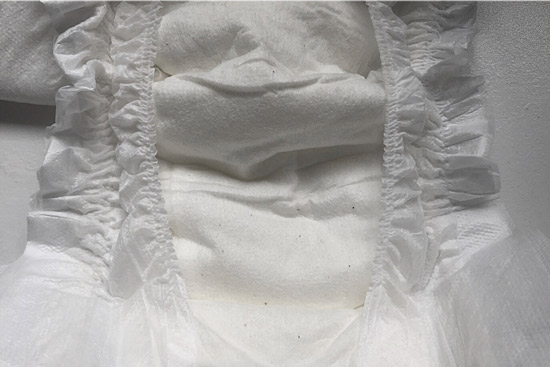
The cotton Kudos uses is non-GMO but not organic. Conventional cotton is known as the world’s “dirtiest” crop when it comes to the use of pesticides. Kudos diapers are OEKO-TEX STANDARD 100 certified which is a testing method that screens for several hundred harmful substances, although not all cotton pesticides seem to be on that list just yet.
As for the rest of the ingredients, the back sheet of Kudos diapers is bio-based polyethylene (sourced from sugarcane) and synthetic polyethylene in the leakproof barrier. The absorbent core uses sustainably sourced totally chlorine-free fluff pulp (FSC certified) in addition to SAP, and bio-based polyester and polyethylene in the acquisition/distribution layer (from corn starch and sugarcane). The remaining components are made with petroleum-derived materials (core wrap, leg cuffs, closing system, elastics).
Kudos diapers in a nutshell:
Kudos offers printed diapers (two gender-neutral designs are available in each size) as well as plain white diapers. All sizes have a wetness indicator. The core feels luxuriously thick and features a patent-pending dual acquisition/distribution layer with a high capacity to capture and distribute moisture.
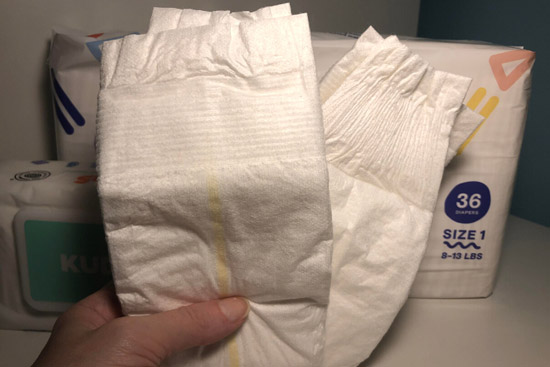
There are no add-ons in the top sheet of Kudos diapers. The back panel of Kudos diapers is stretchy, and flexible side panels create a comfortable fit.

Diaper size isn’t indicated on the back sheet, but the right side tab has that information on the underside (SZ1 = Size 1).
Kudos diapers are available exclusively on the Kudos website. After you pick a size and print, your options are a one-time purchase of a monthly box (6 packs of diapers), or a monthly box subscription. You can add 4 packs of baby wipes to both options. All boxes are tailored to one size only, and you save 11% with the subscription model. Single packs of Kudos diapers currently don’t seem to be available for purchase – making it a bigger investment to just try the diapers, but Kudos does offer a 45-day guarantee and free returns if you’re not happy with your purchase.
As of September 2022, Kudos diapers are manufactured in Mexico (used to be Europe – Germany).
With the change of manufacturing plants, the diapers are now cut a little bit differently – they are more narrow, so the weight chart has been adjusted to accommodate for the slight difference. Some of the packs have the old sizing. The sizing chart on the Kudos website (see below) is the accurate one.

Good to know: Kudos diapers run small. They have good length but aren’t very wide. If you’re in between sizes, Kudos recommends to size up. Nonetheless, keep in mind the narrow width when ordering if your baby packs those adorable chubs. 😉
Eco-friendly points: several bio-based ingredients in addition to 100% cotton top sheet (inner liner), sustainably sourced FSC-certified TCF fluff pulp in the core, and bio-based polyethylene packaging (sourced from sugarcane).
KUDOS diapers reviews:
+ Absorbent
+ Soft
+ Cotton top sheet
+ Stretchy
+ Wetness indicator
– Small
– Fulfilling orders might be a tad slow ATM
Summary:
- Kudos is the first and only disposable diaper where the top sheet is 100% cotton. If you’re looking for a disposable diaper that’s non-toxic and about as all-natural as it can be in the top sheet, then Kudos is a great choice!
- Currently there seem to be delays with some shipments and incomplete shipments (they may be low on some sizes), and customer service doesn’t seem as responsive as is typically the case for Kudos. This might just be the aftermath of experiencing a sudden increase in demand following the deal Kudos scored in Shark Tank earlier this year (did ya’ know??).
- With all that said, I hope the above is resolved soon because I do believe that Kudos is a very unique diaper.
— LITTLE TOES


Buy on Amazon | Little Toes
Wetness indicator: Yes
Sizes: S, M, (L/XL as pull-ups)
Cost: $-$$-$$$
Free of: fragrance, lotion, chlorine, dyes, latex, alcohol, PVC, PABA, parabens, TBT, phthalates
Made in: China
Little Toes is another bamboo diaper on this list.
What are Little Toes diapers made of?
The top and back sheets of Little Toes diapers are made of bamboo viscose. The rest of the diaper components with the exception of the fluff pulp in the core seem to be derived from petroleum (crude oil).

Little Toes diapers in a nutshell:
Being made predominantly of bamboo fibers, Little Toes diapers have a soft texture. They have an elastic waistband that’s color-coded by size. All sizes have a wetness indicator.
The difference from other bamboo diapers on this list is that Little Toes diapers are printed. The design has recently changed from colored circles to a green-colored nature-inspired pattern.
Another change is that only sizes Small and Medium are available as a traditional diaper with resealable closing tabs, whereas sizes Large and XL are now a pull-up diaper. Newborn size is currently not available. Feedback indicates that even in this smallest size the fit wasn’t right for most newborns, so perhaps it’s back to the drawing board on that one.
Little Toes diapers are available on Amazon (check availability here) and the Little Toes website where they are offered as single packs or a monthly subscription that includes 6 packs of diapers + 3 packs of baby wipes. There is currently no option to subscribe to just the diapers only.
Good to know: Little Toes diapers run big. Keep that in mind when ordering, especially if your baby is in between sizes.
Eco-friendly points: top and back sheet made of sustainable bamboo.
LITTLE TOES diapers reviews:
+ Soft
– Large
– Not a newborn diaper
– Wide weight range for each size
Summary:
- With only 4 sizes available for a range of 6.5 – 40 lbs, the range for each size is quite wide, so it may be tricky to get the right fit necessary to avoid leaks.
- Little Toes diaper subscription automatically has baby wipes included, so keep that in mind if you have already found your perfect baby wipes.
- Little Toes diapers traditionally had great reviews throughout the past updates, but I haven’t seen enough recent feedback to confirm with certainty that they’re still a great diaper. If you are using Little Toes diapers, I would love to hear from you!
— Pura

Wetness indicator: Sizes 1-2
Sizes: 1-7
Cost: $-$$-$$$
Free of: fragrance, chlorine, lotion, latex, parabens, phthalates
Made in: Europe
Have you heard of Pura diapers yet? Pura is a U.K.-based brand of diapers and wipes founded in 2020 that just launched in the U.S. (June 2023).
What are Pura diapers made of?
The top sheet is made of plant-based polyethylene (from sugarcane) and polypropylene. Plant-based polyethylene is also used in the leakproof barrier of the back sheet. The back sheet cover contains polyester, polyethylene, and organic cotton. Cotton fibers make up 15% of the back sheet, and the cotton is U.S.-sourced and certified.
The core contains SAP (super absorbent polymer) and totally chlorine free fluff pulp that’s sustainably sourced and FSC-certified, and the leg cuffs are made of plant-based polyethylene and polypropylene in addition to elastics. The rest of the materials around the core and the closing system are all synthetic.
Pura diapers in a nutshell:
Pura diapers are printed with a gender-neutral design pattern in the color orange.

The Pura logo is printed on both the front and back of the diaper, and the front panel features a diaper size. The back isn’t elastic but the side panels are.

Eco-friendly points: several plant-based components, sustainably sourced FSC-certified TCF wood fluff pulp, paper packaging, made with sustainable practices, low environmental impact (EU Ecolabel).
Pura diapers are available on walmart.com and some U.S. Walmart stores in some locations.
Since Pura diapers are new on the U.S. market, most of the reviews at this point are from free product testing for reviews programs which, in my opinion, tend to be heavily skewed in favor of the product being tested. There is a wide feedback pool of reviews coming from the UK though, so that’s mostly what I’ve used for performance evaluation of Pura diapers FOR NOW until more reviews are populated here in the U.S.
PURA diapers reviews (UK-based):
+ Soft
+ Thin
+ Sturdy tabs
– No wetness indicator for sizes 3 & up
– May not hold enough overnight
– Not a newborn diaper
Summary:
- Pura diapers contain a surprising amount of plant-based materials for their price point.
- This is a very thin diaper, which some appreciate and others don’t. To sum up the performance of Pura diapers, I would say they have good total absorbency for how slim the core is, and average protection from leaks. If you’re used to a thicker, more absorbent diaper, you may need to change diapers more often with Pura.
- Pura diapers have a wide core, which is generally a plus, but all that extra material can make the diaper too large for most newborns even in the smallest size (Size 1).
- Does Pura belong on this best non-toxic diapers list? It certainly seems to be one of the safest diapers on the market made with care for the environment. If you try Pura diapers, I would love to hear your feedback!

This concludes the list of the Best Non-Toxic Diapers 2023. Scroll down to see all featured brands compared side-by-side on those key metrics.
Best non-toxic diapers 2023 – comparison:
| Cost | Plant-based* | Rating | Shop | |
| Abby & Finn | $$ | X | ★★★☆☆ | Buy |
| Andy Pandy | $$$ | ☘ ☘ ☘ | [TBD] | Buy |
| Bambo Nature Dream | $$ | X | [TBD] | Buy |
| Coterie | $$$ | X | ★★★★★ | Buy |
| Eco Pea | $$$ | ☘ ☘ ☘ | ★★★★★ | Buy |
| Happy Little Camper | $$ | ☘ | ★★★☆☆ | Buy |
| Healthybaby | $$$ | ☘ ☘ | ★★★★★ | Buy |
| Joonya | $$$ | ☘☘ | ★★★★☆ | Buy |
| Kudos | $$$ | ☘ ☘ ☘ | ★★★★★ | Buy |
| Little Toes | $$$ | ☘ ☘ ☘ | ★★★★☆ | Buy |
| Pura | $$ | ☘ ☘ | [TBD] | Buy |
Rating: best = ★★★★★
Finding the best diaper that’s safe & non-toxic
Keep in mind that there is no single best disposable diaper out there that works in the same amazing way for ALL babies. Babies come in all shapes and sizes. What works for one baby may not work for the next, which makes diapers impossible to effectively compare.
As parents we sometimes have to go through the hell of trial and error before finding the BEST kind of diaper worth sticking with. (Yay parenthood!)
Consider doing a test run with a few of your favorites and see which diaper brand you feel outperforms the others for you.
I should also mention that I only included reports of leaks, rashes, and blowouts (and other performance issues) if they were prevalent among the reviews. When there is a pattern, I want you to be aware. This of course doesn’t mean that every single parent will experience that issue.

Want more tips on how to curb toxicity in your baby’s life? After all, the health of your baby is super important, right? Here are more resources for non-toxic baby care that you may find useful:
- Common Toxic Chemicals in Disposable Diapers
- #MomHacks: Using Sunscreen for Diaper Rash
- Best Natural Baby Wipes
- Can You Use Diaper Cream as Sunscreen?
- Best Natural Baby Toys
- The Single Best Alternative to Baby Powder
- Glass Baby Bottles vs. Plastic Bottles
Final words:
A lot of research and a TON of hours go into updates of this safe & non-toxic disposable diaper review (believe it or not). Product information is sourced directly from individual manufacturers (except for where I clearly state my opinion). Review evaluation is based on the information I’ve collected from multiple relevant sources (I try to use as many as possible in my research). I’m only a human though, a very tired human with 2 homeschooled kiddos who has added a four-legged high-strung utterly adorable friend to the mix. If you spot any errors, please do let me know!
All opinions are my own. Not a single brand is paying me for investigating the topic of the best non-toxic diapers and putting them first.
This post gets updated periodically. To be notified of future updates, like/follow Wholesome Children on Facebook where the updates are posted. (PS: I should really up my social media game; no worries about spamming your wall with endless posts…) Or, check back on WholesomeChildren.com from time to time. You can also bookmark this page. Whatever works for you.
Helpful links regarding diaper certifications:
- OEKO-TEX Standard 100
- SGS certification
- OK Biobased
- FSC certification
- Nordic Swan Ecolabel
- EU Ecolabel
If you’ve found this review of the best non-toxic diapers helpful, please spread the word and share with like-minded friends who are wondering about the safest diaper brands. Thank you!!
Questions? Ask away! 🙂




UPDATE: I have used one package of Pura diapers for my 6mo. I’m not a fan. They were my patch till my Healthy Baby order arrived. I wouldn’t consider her a heavy wetter and HB does a great job from about 11:30p-7:00a or so. Not so, Pura diapers. She leaked most mornings and also had several poop diapers leak. I feel like the fit also ran small. I have almost an entire package of them left and will save them for the next emergency, lol, but won’t buy again for my baby girl.
Thank you for sharing, Jennifer! Though the two brands have many similar features, it’s undeniable that Healthybaby diapers have significantly more absorbent material in the core and are thus made to perform better. If one can make Pura diapers work, they’re a great deal for having several attractive eco-friendly features for that price range, but I do anticipate that absorbency and leaks are likely to be an issue for those who have tried premium highly absorbent diapers before.
Hey,
How does everylife diaper compare in regards to its quality of materials used/ reviews?
Hi Laura! Everylife diapers were not considered for this guide since they aren’t TCF (totally chlorine-free). To summarize, they are ECF (elemental chlorine-free) and petroleum-based. No lotion or fragrance, and advertised as phthalate-free. Made in Mexico. I haven’t researched what the feedback is on them, though. I would size up – they run small.
I have used your list to try several different brands including, most recently, Little Toes and Pura. We were between sizes on Little Toes and sized down. They did not hold up overnight and they left behind a lot of lint. The wipes are not my favorite – a soiled diaper usually takes 4-5 wipes to clean thoroughly, and they have a noticeable smell (I know they’re fragrance free). We’ve been using Pura for overnight while we use up the rest of the Little Toes during the day and they have held up great! No lint, very soft. The wipes also have a noticeable smell but seem a bit sturdier than Little Toes. I’m going to try Joonya next. They had a better price point than buying Pura from Walmart but I just found Pura on Amazon for about the same price. I see that Joonya is updating sizing and adding pullups soon. I’ll be interested in trying those. I may try Little Toes again in a larger size when closer to potty training. They are very soft and my child is able to help pull them on and off. Thanks for making this guide available!
TY for your feedback Laura! Bamboo diapers do leave some lint on the skin. I think all brands do, it’s just the nature of the fiber itself. The wipes… I’m thinking it’s aloe. It tends to have a strong odor. Yup, the Pura line of diapers and wipes should be available on Amazon at this point – I’ll have to update and include all links. TY for the reminder! Joonya is also switching their manufacturing facility. The new diapers will be different. 🙂
Just wanted to let you know I got some info back from Coterie today when I was asking if their cotton was organic:
“ I’m happy to inform you that our products do not contain cotton. Instead, we use plant-based pulp sourced from sustainably managed forests.”
Did you mean Kudos, Mike? Coterie diapers have no cotton fibers in any of the layers.
We will try these Pura diapers and see how they perform! We were pretty happy with Little Toes but lately we’re getting some rashes here and there (still one of our favorite though). Also experiencing issues with shipping because we live in a rural area so shipping can be a problem sometimes. Thank you so much for updating your list and giving us other safe options!
Sounds great, Zunilda! I don’t think they’ll be as absorbent as Little Toes diapers just based on the core thickness, but if you’re getting rashes, it’s a good idea to try other options anyway.
Hi, I was wondering your thoughts on
1) parasol diapers
2) pampers pure? Are pampers pure still TCF? Their site is confusing regarding this information.
3) Dyper Diapers
Ha Clarissa – Parasol diapers are TCF. They finally disclose that on their website (I wasn’t 100% sure beforehand although I had multiple email confirmations from them). Performance is mixed; certainly for a premium-priced diaper it could be a bit better. But there is no lotion or fragrance, so that’s a plus in keeping baby safe. Pampers Pure diapers are no longer TCF. They started as such but quietly switched to ECF about two years ago. When I spoke with a Pampers rep right after the change, they wouldn’t even admit that anything has really changed. Dyper diapers are not currently TCF (they used to be), so they’re not on this list since chlorine bleaching is a ranking factor.
I emailed both Dyper and Pampers and these are the replies I received. Regarding being TCF. The wording confuses me. Dyper says chlorine free but they are also ECF? The wording from both companies is confusing to me.
**DYPER DIAPER**
Our dyper diapers are chlorine free. We currently use an elemental chlorine free (ECF) bleached, Forest Stewardship Council (FSC) certified wood fluff pulp in our absorbent core. ECF bleaching is a chlorine-free process in that no elemental (molecular) chlorine is used in the bleaching sequences, and has been shown to result in an end product that is free of dioxins and toxic chemicals. In addition to this, ECF fluff pulp has been found to produce more fluff pulp using less resources, making it a more sustainable option when compared to totally chlorine free (TCF) bleached fluff pulp.
**PAMPERS PURE:**
Pampers Pure Protectin diapers are great for babies with sensitive skin because they are crafted with premium cotton, soft plant-based fibers, and other thoughtfully selected materials. They’re dermatologically tested and hypoallergenic for your baby’s delicate skin. They are also made without chlorine bleaching, fragrance, parabens, latex, and the 26 allergens the European Union has identified as most likely to cause skin allergies.
We appreciate you writing to Pampers. I hope I was able to answer your questions. Please reach out to us anytime if you have further questions.
Hi Clarissa – it’s confusing and the manufacturers know it, so oftentimes they play the game to get more business. By “chlorine-free” they just mean “not bleached with elemental chlorine” (chlorine gas) which is something both ECF and TCF diapers have in common.
Elemental chlorine is very toxic and detrimental for the environment and was used to bleach the fluff pulp used in diapers decades ago. Some countries may still follow this practice, but I’m not aware of any diapers on the U.S. market (including imports) using pulp bleached with elemental chlorine. Current practice is either elemental chlorine-free (bleached with chlorine derivatives like chlorine dioxide) or totally chlorine-free (no chlorine compounds whatsoever). Chlorine dioxide bleaching (ECF) is day and night difference in safety compared with elemental chlorine bleaching (no longer used), but not as clean and environmentally friendly as totally chlorine-free bleaching. It is however true that more pulp is wasted with totally chlorine-free bleaching. ECF processing produces more pulp from the same batch volume compared with TCF bleaching. It’s just two completely different methods. Also with improved technology and practices, more contaminants are captured in closed-loop systems nowadays with ECF bleaching instead of released into the environment. ECF bleaching does produce low levels of dioxins and furans (depending on the purity of chlorine dioxide and the particular bleaching sequence) that simply pass the threshold levels that are deemed acceptable. I discuss that here if you have a moment.
Both DYPER and all PAMPERS diapers are currently made with ECF (elemental chlorine-free) fluff pulp. Whenever you see a “chlorine-free” label on diapers (ALL diapers in North America are “chlorine-free”), it typically means ECF diapers. Most TCF diapers will have that “totally chlorine-free” disclosure somewhere on the box or website because in a way that justifies a higher price tag (TCF fluff pulp costs more to produce compared to ECF fluff pulp). Interestingly, both DYPER and Pampers Pure started off as TCF diapers and built their name on that, but later made a quiet switch to ECF.
Hi,
I noticed a distinct difference in my Coterie diapers from two different shipments between June 2023 and July/August 2023 – almost as if they changed crucial materials between the two lots. The latest Coterie shipment was noticeably thinner, objectively stiffer and not as soft! They felt like a different product- some even seemed to have a faint chemical smell! These are very clearly two different products even though they have claimed nothing has changed! Have you heard anything about this from others? Wondering if they are cutting corners? I used to swear by Coterie but now I’m wondering if I should switch to EcoPea or Kudos?! Thanks!
Hi Jenna, that’s strange. The ingredient list doesn’t seem to have changed, but sometimes just changing a material supplier can give a diaper a different feel, and those changes can be temporary or long-lasting and neither is typically disclosed. I can’t tell you if Coterie is trying to cut corners, but it’s not uncommon to still encounter material shortages in 2023 in the diaper industry, so it could be a number of things. As always, if you’re having doubts, go with you mama instincts and give another brand a try! 🙂
Hi, I was wondering your thoughts on parasol diapers and pampers pure? Are pampers pure still TCF? Their site is confusing regarding this information.
Hello! Thank you for the 2023 list! Curious about the Dyper brand? And I’ve also seen a new supposedly super clean diaper on social media called Everylife. Have you heard about this new one???
Hi Kelly – Dyper uses elemental chlorine-free fluff pulp, thus it’s not included on this list which only features TCF (totally chlorine-free) diapers. Not a reason not to try them, it’s just that the bleaching method is a ranking factor for this particular list.
I’ve tried most of the diapers on this list (thanks to this list!) with my nearly 2.5 yr old and Bambo Nature has been the best performer for us. We’ve never had a single blowout with this brand. Never had any quality issues with this brand, and they absorb so well we’ve never even had to purchase the nighttime version! They’re also super soft, have no scent, and are easy to put on due to the stretchy sides.
I tried switching to HealthyBaby but the quality issues and difficulty in getting the diaper to close well as well as inconsistent sizing in those outweighed how soft and non toxic they are. Because of their difficulty we get leaks and the diapers fall off my daughter is she’s not wearing a onesie (which is rare now at over 2).
I was super surprised to see you were befuddled in why people like Bambo Nature because they’ve been such an awesome diaper for us.
Thanks for all the work on this list and for keeping it updated!
I’m so happy to hear you’ve found the list helpful! Thank you for your feedback on Bambo Nature diapers – it’s much appreciated! It’s the only diaper on the list with such conflicting reviews – which is so frustrating for me because performance is such a big part of the review. 😉
Hi! Any thoughts on thrive market diapers? Thank you for all you do! 🙂
Hi Cynthia! Thrive Market diapers are TCF and made with both synthetic and bio-based fibers. Truth be told, there are many similarities to Honest diapers, although they each have a different top sheet. The price point is similar as well. Performance reviews are mixed. I think they run a bit small and it’s not the softest diaper out there (just like Honest diapers), but many are happy with them nonetheless. I believe Thrive Market diapers don’t have a wetness indicator.
I thought the group may like to know what I received back from Kudos when I asked if they test for glyphosate and chemicals for their harvested cotton.
Below is their response:
Hi Mike,
This is Grace from Kudos, thanks so much for reaching out!
All cotton farming uses pesticides, even organic cotton. All pesticides used in the USA are controlled and regulated by the EPA. All pesticides used on cotton are approved for use in and around your home. The unique process used in our cotton washes even minute amounts of pesticides off the cotton.
It’s important to note that glyphosate applications stop months before the fibers are even formed in the plant. The Bremen cotton exchange tests raw cotton for pesticides every year and has never had a fiber that wouldn’t comply with OEKO-TEX® STANDARD 100. You can learn more about our cotton here: https://mykudos.com/blogs/news/unique-benefits-of-the-trucotton-used-in-kudos-diapers?_pos=1&_sid=3ff241c02&_ss=r.
Hope this helps! Let me know if you have any more questions 🙂
Grace
Thank you for sharing, Mike! In my opinion, OEKO-TEX is a good standard for man-made fibers but not so much for cotton because pesticides aren’t covered by OEKO-TEX in a wide enough range just yet. Is the broad statement that “all pesticides used on cotton are approved for use in and around your home” really true? I would disagree with that one. I’m nowhere near qualified enough to speak on the frequency of chemical applications on cotton crops and the timeframe of use for specific pesticides so I won’t address glyphosates specifically, but herbicides are used in the U.S. shortly before harvest as harvest aid to increase the rate of leaf loss in conventional cotton production (such as paraquat – one of the most dangerous herbicides banned in many parts of the world). That said, I still love the direction Kudos has taken with a cotton top sheet and it’s possible there is no detectable residue on the cotton they use, and frankly, using certified organic cotton fibers would be cost-prohibitive.
These are all really great points! Thanks for sharing your feedback on their. I agree with you on everything you have written. I’ve never heard of pesticides being used around the home that seems strange. I’ll ask for a list of pesticides used on the cotton and see if they’ll give it to me.
Continually seems to be difficult to find a great option that checks all (or most) of the boxes for a go to diaper and go to wipe. It’s also hard when the companies that we trust/like change from TCF to ECF.
Looking forward to your updated 2023 diaper reviews, thank you for all that you do!
I’d love to see the list of pesticides used on the crops if they’re willing to share that! I’m putting all my efforts into publishing the updated list in its final form ASAP but am still waiting to hear back from a few brands and waiting on some samples. As for ECF/TCF specifically, Millie Moon and Hello Bello were the only two brands removed based on that criteria.
I’ve asked them for the list of pesticides and will let you know if I hear back!
I noticed you mention that all diapers on your list are TCF. Millie moon is on your list and as it is the diaper I am using I periodically check back and noticed their website now says they are ECF.
Hi Tiare! I’m currently updating the guide for this year. Please check back in a few days to see if it’s ready – I have over 70 brands to go through, one by one. I will post it on FB once it’s ready. You are correct, Millie Moon diapers are no longer TCF (happens all the time in the diaper industry). Nor is Hello Bello.
Have you reviewed Attitude Diapers? Curious to hear your thoughts.
Hi Kate! I have not. There aren’t a ton of reviews out there. The only thing I can say with confidence about Attitude diapers is that the fluff pulp is totally chlorine-free and they contain no fragrance or lotions. The only way I could put all TCF diapers out there in one review is to perhaps create an e-book, but in this format I have to keep the list trimmed for the page to load properly.
Same here! Attitude is my favorite brand for almost everything, especially when it comes to children’s stuff, but I’ve never tried their diapers.
Hi Clarissa,
I was wondering if you had an opportunity to look at Ecooriginals diapers and what are your thoughts on it.
Thank you!
Your website and this post has been a lifesaver in my hunt for baby safe and environmental conscious. Ultimately baby safe is my #1 and unfortunately my husband was not down with cloth diapers. I bought Kudos and have been using them for about a month. Their size one was too big for my newborn (7lb 8oz, 20” long). Once he fit them, they worked like a dream! He never had moisture sitting on his bottom. I didn’t realize this was an issued with diapers (FTM) until we ran out and I had to reluctantly use mama bear Amazon diapers that someone had gotten got us.
We’ve had no leaks or blowouts in the kudos diapers. I love them! we’ve had no issues with their wipes however compared to some alternatives, they don’t seem as soft.
No diaper rash or issues so far and we are big fans of the kudos brand!
It can be tricky for sure to find a diaper that fits a newborn well. They are so tiny and many brands start off with lots of bulk even in the smallest size. I’m so glad you were able to find a good fit with Kudos diapers eventually and that they work for you! Thank you for your feedback on their wipes – I have requested a sample but they seem to be short-staffed at the moment.
I emailed kudos about their sizing because I noticed they changed the ranges compared to my packaging purchased in 2022. I wanted to share their response:
“we recently added a new manufacturing facility (using all of the same, super safe ingredients we have always used) to allow for quicker shipping times. With this change, there were some small changes to sizing — which is why you see the discrepancy.”
Based on the ranges they used to have on the packages and the fact that their site says to size up… it looks like the issue of them being too big for the quotes sizes has been resolved!
Now that I’ve used some more brands of wipes… I’m back on Kudos because they’ve been the best with pulling through our wipe dispense (others I keep having to rethread) and they are LARGE in surface area. My husband still seems to burn through them like they’re going out of style and free lol
Also if you can’t get a sample I’m happy to ship you some! Your site was so helpful and would be happy to contribute!
Hi Tonya – I love that you’ve mentioned that! I actually have a question for you – I caught that and believe it’s Shark Tank aftermath since they’ve expanded production to Mexico now as well. What I can’t figure out is whether they’ve just shifted the weight chart or if the size of the diaper has changed as well. Do you think the diapers themselves are the same size as they were last year? Would love to hear what you think! TY! And thank you for your feedback on the wipes. Always appreciated! (Also I want to thank you for your generous offer to send me a sample – I continue to badger Kudos but I have to say based on current reviews they seem to be way understaffed ATM and selective with their responses, probably as a result of higher exposure with Shark Tank – but I will let you know if I get desperate! LOL Thanks so much again!!!)
I asked that particular question actually! Their response (my email is needed for context) does claim they physically changed the diapers. I just ordered size 3 and have a bunch of “old” size 3 that baby boy has not grown into. I will report back.
Keep me posted on the wipes! I can also send one of each of the size 3 so you can compare yourself too! Excited and happy to help – I was seriously going insane trying to figure out what you so conveniently collected into one page (I cannot fathom the amount of research!)
I have to correct my assumption about the manufacturing expansion to Mexico being related to Shark Tank because I do have a mention in my notes that they had made the change last September. Anyway, as for the size, just based on the old and new chart alone and knowing that Kudos diapers ran small since they launched, I’m leaning towards a design change as well for the new sizing to make sense. But at this point of investigation for this update my brain is very cluttered so I can’t rely on my ability to do basic math, haha.
Hi! I wanted to let you know I held my pre-Mexico facility diaper next to the latest Mexico facility diaper, and there was no noticeable change. They definitely run small as I was in the size 3 when according to the weights, I should’ve ordered size 2.
Great news, healthy baby is at target! I haven’t received mine yet but pretty handy when you just need one more small bag of diapers versus a whole box to get free shipping from the manufacturer site.
Thank you for your reports, Tonya! I so appreciate you! 🙂 I agree – the convenience of being able to just grab an extra pack of diapers in the store is a HUGE plus.
Sorry I am adding more for parents looking since i thumbed through the comments to do my research.
I got my healthy baby diapers and I much prefer the kudos (even though the all organic cotton in the healthy baby pulls at me).
The healthy baby diapers are so soft! But they’re so soft that I can’t seem to get them to stay on the baby. There’s no really structure to them… Hello plumbers crack. Perhaps they are more comfortable for the baby? But I’ve never had any indication my baby didn’t like the kudos.
I also wish healthy baby had the urine line indicator… I’ll definitely order healthy baby from target when I need a bag or two to get me by though.
Thank you for sharing, Tonya, and letting others know about your experience! 🙂 LOL at the plumber’s crack. Both Kudos and EcoPeaCo diapers will give that extra study feel throughout the diaper. 🙂
Hi Marketa, thanks for the article. Looking forward to the updated 2023 list. Will the 2023 list include Thrive Market’s diapers?
If they make the list – TY for the mention, Tara, I have added Thrive Market diapers into the mix of brands to review. 🙂
Thank you for all your research and hard work! This article is truly informative and helpful! Again, Thanks a lot❣️
Thank you Zunilda, your comment means a lot to me! I’m finally scheduled to begin the [very overdue] update this weekend, so please check back in a few days to see the current brand standing for 2023! 🙂
Oh great to know! I will definitely check back in a few days! I would also wanted to thank you for your response about the glass bottles I asked you about. I’m actually throwing away everything that is not safe in my house! I didn’t know about Tamara Rubin and her work. Thanks a lot for all that you do and for sharing!
I’m glad I could help, Zunilda! Ah the purge – I think it’s a wonderful thing you’re doing for your family. 🙂
While you are putting together the 2023 update, would you mind sharing your cure t favorite diaper and wipe as I’m about to re-order? I’ve been using Nest but heard they aren’t as clean anymore, and same for water wipes. Much appreciated!
The Baby Wipes Guide is in need of an urgent update and I will be working on that one as well. Although I often see new formulations of baby wipes being released and material changes with baby diapers, over the past two years there has been an increased shuffle in materials/ingredients due to widespread shortages, disruptions of the supply chain and sharply rising costs in virtually all sectors that I wanted to wait for the market to settle a bit. I think we’ve reached that point of some normalcy again. I don’t want to publish a new guide for parents to rely on and for that information to not be relevant a mere couple of weeks later. Lots of companies have made numerous adjustments recently for a variety of reasons, but it seems like those changes are at least sticking now. At this moment as I go through each brand one by one I don’t have any clear recommendations to give just yet – I hope you understand! Nest is a company that tries to make a difference by consistently expanding and experimenting with various plant-based components in an attempt to lower the burden on the environment. Nest diapers aren’t included in the review as they were not totally chlorine-free. I haven’t seen the current material list for 2023 just yet, so I can’t elaborate on the safety or eco-friendliness of any individual components. If by water wipes you are referring to the actual WaterWipes brand, from what I’ve seen there has been no change in the ingredient list so the information from the last baby wipes guide is still relevant. The only change for now seems to be making the wipe material fully plant-based by removing polyester fibers (which I believe made up 80% of the wipe material previously). Hope this helps!
Does anyone have a go to 2023 brand they like? I have been using Andy Pandy and Nest, but now I am reading that Nest isn’t TCF so I need to switch up to a new brand. Any current favorites someone recommends while Marketa puts together the new list? Also, Marketa, you are so awesome for doing all of this research. Thank you!
-Mike
Exciting!!! Thank you for all that you are doing Marketa!!!
My pleasure, Mike! Thank you for stopping by! 🙂
When will this be updated for 2023?
Hi Kate, thanks for stopping by! It’s on my to-do list, but I don’t have a date on it yet.
Amazing looking forward!
Hi everybody just letting you know millie moon isn’t TCF anymore and is now ECF I’m so upset as I loved these diapers but in case you guys didn’t know im letting you know.
Oh that’s a bummer! Thank you Mikayla! I have a feeling there are going to be lots of changes once the article is updated with the multitude of companies cutting costs left and right to stay competitive and afloat.
Hello,
Millie Moon is no longer TCF! Just wanted people to know that!
Thank you, Nicole! 🙂
Hello Bello also no longer uses TCF 🙁
TY, Tara, you’re on it mama! 🙂 What I find interesting is that their approach to the announcement is following: “In the case of our diaper core, due to supply chain issues we had to swap out our TCF fluff pulp for ECF fluff pulp.” But the wording doesn’t suggest they’ll revert back to TCF pulp when it becomes possible to do so. I think this one might be sticking.
Thank you for all the work you did to create this list! I found it very helpful! Important to me are functionality, plant based/clean ingredients and NOT China-made. I only plan to use disposable on occasion as I love cloth diapering my babies. But those newborn days and traveling situations call for some disposable options!
I’m glad you were able to narrow down your options, Jennifer! I love that you are using cloth, but I hear ya, there is definitely time and place for the more convenient disposable options. 🙂
Hi there! Have you ever looked into joonya diapers? Would love to hear your opinion on those!
They are safe by my standards! TCF, no fragrance, no lotion. No phthalates, formaldehyde, or heavy metals based on third-party testing. The top sheet is plant-based, the back sheet is cotton-enhanced synthetics.
Hello!
Have you heard of Nateen Premium Diapers? I was using Ecopeas and Nest before they made changes and now I’m on the look out for new diapers.
Thank you!
I see very little disclosure on Nateen diapers provided by the company and no real brand presence in terms of accountability. I wouldn’t expect the diapers to be totally chlorine-free. Although they are advertised as 80% biodegradable, the top and back sheet material is stated as polypropylene without any additional information on sourcing. I really don’t have any useful information to give you a solid answer about this brand and whether they would be a candidate for this list of the best non-toxic diapers. May I ask about your dissatisfaction with the latest version of Eco Pea diapers? TY!
I saw you wanted replies about bambo. I’ve been using Bambo Nature for years (original and dream) + (diapers/pull-ups) for two babies/toddlers. I’ve always had great absorption, no rashes, fit well, etc and actually preferred the dream version. I’ve tried a few others and always end up back at bambo. But I have to be honest I (like you said most Parents) always thought they were “safer” and after reading your review I was like what?!? I originally came to your page because I was looking for a cleaner alternative that aren’t so pricey. So now I’m looking because they weren’t as safe as I thought and a cheaper alternative. Would love to know if Costco Brand are considered safe/would be on your list?
Hi Lindsay! Thank you for sharing your experience with Bambo Nature diapers – it’s much appreciated! 🙂 The name is misleading. Sadly. On the plus side, Bambo Nature diapers contain 100% chlorine-free fluff pulp in the absorbent core in addition to being made without fragrance or petroleum-based lotions, which still makes them healthier and safer for baby (and the environment) than many other brands. If you’re looking for a natural material against your baby’s skin, then I would consider cotton diapers like Kudos. However, be aware that cotton that hasn’t been grown organically can be heavily contaminated with agrochemicals. In the end, fibers made from bamboo and other plants like corn or sugar cane are just as man-made as petroleum-based fibers; the difference is in the nature of the material itself and sustainability. Bamboo has an added benefit in being extra soft and sourcing since it has minimal impact on the environment and typically doesn’t require chemical treatments like other crops do (here are more details on disposable bamboo diapers and how bamboo fiber is made… if you’re interested). To answer your question – Costco diapers (Kirkland Signature Diapers) are petroleum-based and made with elemental chlorine (they are NOT totally chlorine-free) but contain no perfume or fragrance. They do have a wetness indicator.
Thanks for looking into Nateen. Perhaps I’ll skip them – I appreciate it when diaper companies disclose the information on their diapers openly or I feel they’re hiding something.
I really like Ecopeas and had a subscription but they changed their sizing and their new diapers were too narrow for my chubby baby – even their largest size. She kept leaking out. Although not the best, I feel Bambo fits my baby the best and she never leaks out of them, even when worn over night.
Yup, unfortunately, diaper companies are often making changes for a variety of reasons. Eco Pea changed their sizing right around the time Dyper did – sorry to hear they no longer work for you. Luckily there are lots of brands to choose from these days!
Hi! Thank you so much for the work you put into researching and reviewing all these diapers, it is so helpful! I have been rotating between coterie, kudos, eco pea and healthy baby diapers and really like them all. My baby is now a year old though and none of them can handle overnights. He always wakes up in a puddle of pee. Do you have any favorite over night diapers? It seems like most are pampers/honest type. Thank you!!
Hi Cara, thanks for stopping by! Oh that’s a bummer! You’re right – a nighttime diaper isn’t too common for most companies. Hello Bello, Seventh Generation, and Honest offer a nighttime diaper, but the reviews aren’t exactly stellar. Are the diapers at capacity and completely drenched in the morning or are there dry spots, suggesting plain old leaks? Size-wise, do you think the next size up would fit your baby reasonably well? Oftentimes leaks can be avoided just simply by going up a size because with more coverage there is increased absorbency. Babies aren’t as mobile at night as they are during the day and can typically do just fine with a diaper that’s a tad larger as long as there are no obvious gaps around the thighs. Tummy sleepers, in particular, tend to experience more leaks, and some parents resort to doubling up at night (regular size diaper with the next size up over that). There are also disposable inserts available for heavy wetters, although, in full disclosure, I haven’t found any brand that makes theirs totally chlorine-free if you prefer to stick with that. If all else fails, and this greatly depends on your and your baby’s bedtime, another way to cut back on nighttime leaks is to check/change your baby right before you go to sleep yourself. This might buy you a few hours but of course is highly individual. I would also consider limiting liquids shortly before bedtime, unless you are nursing, but you might already be doing that. I hope this gives you a few more options, but if you need to grab a mainstream diaper at some point to stop nighttime leaks – don’t stress over it. It’s totally fine! You gotta do what you gotta do… to stay sane, mama. 😉
I just wanted to say thank you for this thorough and well thought out article! My head was SPINNING looking up a disposable diaper that could align with my eco-friendly and toxic free goals – but also perform. I would love to do cloth but don’t see our lives/schedule allowing that, I might try a hybrid method though.
I just purchased the Kudos diapers which we’re out of stock for a while (although lots of diapers seem to be having this issue). Can’t wait to see how they perform!
So glad I could help with your search for the right diaper that ticks all the boxes for you, Tonya! 🙂 Yep, lots of brands are still having inventory problems, unfortunately. Glad to hear you were able to score some Kudos! 🙂
Love you for it!
Just want to leave a review for you about healthynest. Iv been using healthynest diapers for a while and I’m super tired of red rash on my baby private area (scrotum and penis). Iv never experienced this problem even with pampers or Huggies, I also tried Millie moon and honest. Healthynest are not so great after all. I can do regular type of healthynest diapers for a half day without seeing redness but the pants type of diapers are the worst. I even prohibited my husband to touch closed pack and cancelled pant diapers subscription. My baby is suffering after using even 1 pant diaper. That’s why I’m here on your website and looking for a other clean options.
Thank you for the review!
I’m sorry about your experience with Healthynest diapers. Each baby reacts to each diaper brand in very unique ways, and unfortunately this is something that can’t be predicted. Although it’s definitely weird that the pull-ups are giving you a harder time than the regular diapers since the two are made with identical materials in the top and back sheet and throughout the core. The only thing I can think of is that they’ve made some changes recently and not all shipments are all caught up. If this is a recent issue, I wouldn’t be surprised if that was the case as diaper brands are normally often changing things up, and these days it simply can be due to material shortages and the need to adapt. Interesting – thank you for your input! I hope this list can help you find a diaper that keeps your baby comfortable, and if you’re having a hard time, feel free to send me an email through the “contact me” page and I would be more than happy to discuss your concerns and options in more detail.
Hey there! What did healthy ‘ nest change exactly? I did see they moved their diapers to just being white and numbered on the back and created “channels” to capture wetness etc but I currently use them for our toddler and love them.
Hi Lauren – it seems like the changes you have noticed would be the only ones. I was addressing that I found it odd to see significant reactions in the genital area with either a Healthynest diaper or a Healthynest pull-up but not the other since the two seem to be made with the exact same materials in the top sheet, back sheet, and the core. So if anybody IS seeing any reactions between the two, perhaps it is an aftermath of any changes (no matter how small) that have been made and the old version simply isn’t all out yet. Diaper companies are always working on innovation, or sometimes sourcing becomes an issue and forces the need to try a new supplier, so even if it’s a seemingly minor replacement, there are babies that can react to that. That said, some skin reactions can simply be a cross-reaction between the chemicals used in the diaper and the unique composition of baby’s urine. That’s why some babies just don’t tolerate certain diapers well (or certain changes in the diaper’s composition) no matter what and regardless of how “safe” the diaper is made or certified to be. There is no reason for any changes if Healthynest diapers are working for you guys! 🙂 But I will definitely keep the previous commenter’s experience in mind for the upcoming update so I keep you guys up to speed. 🙂
Hi, any chance you’ve checked out the parasol diapers? I am running out of Kudos (love them!) and they are entirely out of stock, so I’m looking for an alternative that’s not crazy expensive.
Now that Parasol explicitly states on their website that the diapers are totally chlorine-free, I will make a note to add them the next time I update this guide. They are on the pricier side, and petroleum-based. I’m not sure about their performance at this time; in the past their reviews were mixed.
Which cotton diaper would you recommend most? We have tried: Millie Moon, Dyper, Honest, Coterie, Healthy Nest, Little Toes, Eco Pea and Pampers Pure. I prefer the cotton over bamboo for our little. Millie Moon we’re too wide, but other than that so soft and awesome. Healthy Nest was soft too, but it would pull apart the way cotton balls do and get stringy. Coterie is great too, but gets bulgy when wet. We really want to try Kudos and they are all out of stock. Any suggestions on which cotton diaper?
Oh that’s a bummer that Kudos are completely out of stock. I was going to suggest to give them a try. Happy Little Camper also uses a certain percentage of cotton, although I haven’t seen any disclosure on how much. The only brand that comes to mind is Ecoriginals – they are not TCF and the top sheet is made of corn starch (bio-based plastic fibers), but the back sheet is cotton. The back sheet, is, however, the part of the diaper that isn’t sitting next to your baby’s skin. I don’t know what your situation is, but if cotton is high on your list of priorities, would you be open to cloth diapering, maybe even just part-time?
If you can pick one bamboo diaper, would you pick Eco Pea or Little Toes?
That’s a great question, Prinny! If I wanted a printed diaper I’d go with Little Toes, for a plain white look I’d choose Eco Pea. If I didn’t care either way, I’d try both and see which one of the two fits my baby better. Sometimes you can have two great brands such as these, but it all comes down to the right fit. Again, in my opinion, both are a great choice and wonderful brands.